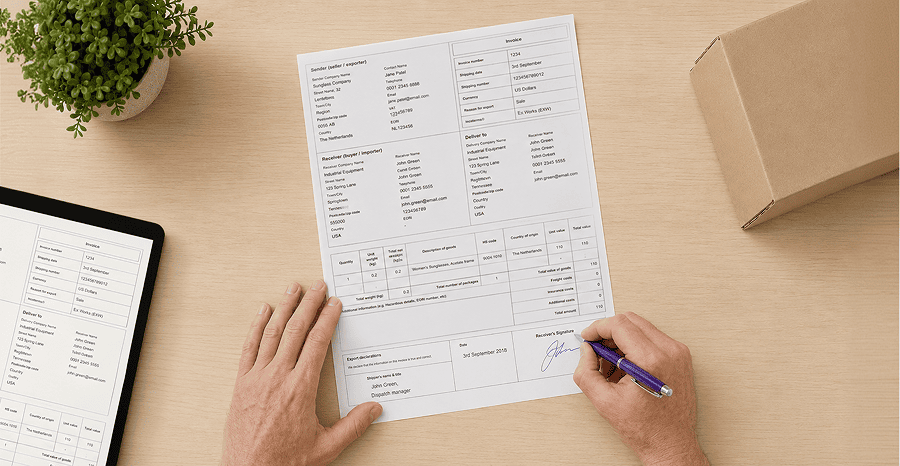


Why commercial invoices matter
A commercial invoice is essential for international shipping. Check how to prepare it with accurate details to avoid delays.
What details do I need to provide?
The invoice should preferably be printed on paper with a company letterhead. The information must be in English and include your company details, such as the address, contact details and tax number. You’ll also need to include the same details about the receiver.
Reason for export
State why you’re sending the goods – is it for trade or is it a gift?
Shipping date and number
The shipping number is your carrier’s number and sometimes known as the air waybill number. You can include your invoice number and order number for admin purposes – but it’s not essential for the authorities.
Incoterms®
This determines who’s responsible for the package during shipping. For more information, head to our Incoterms® page.
Goods description
Describe your goods accurately. For example, instead of just ‘clothing’ put ‘men’s T-shirts 80% cotton, 20% polyester’. And don’t use company product codes to describe the goods. If the package contains branded items, include the brand name as well as the model number. Learn more about providing a clear goods description with our video and guide.
Quantity of goods
If you’re shipping different products, state the quantity of each using an applicable unit of measurement. For example, parts and objects are often counted in pieces, shoes - in pairs, liquids by volume, dry goods by weight.
HS Code
This code informs the customs authorities as to what type of goods you’re shipping. It also helps them asses duties and taxes. To learn more, head over to our page about HS Codes.
Declared value
State the true value of the shipment. This should be the market price of the goods, along with the currency. If the value doesn’t seem reasonable, customs may ask you or your receiver for evidence of the value you’ve declared on the invoice. Find out more about declaring the value of your goods with our video and guide on this topic.
Insurance costs
On the commercial invoice you may need to show the freight and insurance costs as separate items. If not shown separately, customs will calculate these values for you and you may end up paying more than necessary.
Country of origin
This is where the products were originally manufactured – and may be different from the country the shipment is being sent from.
Weight
You’ll also need the NET and GROSS weight. GROSS is the NET weight and weight of the packaging combined.
Finally, remember to sign it.



Make sure to check the rules and regulations of the country you're shipping from and prior to shipping. You can find this information on government websites.
Start shipping with FedEx
Take advantage of great savings and get your shipments moving.