
Service, Regulatory Updates and Important Notifications
Service News
To help us continue providing reliable service during periods of high shipping demand, FedEx will implement updates to our surcharge structure in Fiji, effective September 21, 2026, with the introduction of the Demand Surcharge and the Non-standard Shipment Demand Surcharge. These surcharges will apply to eligible shipments based on the applicable service, shipment characteristics, origin, and destination, as specified below:
Demand Surcharge
The Demand Surcharge will apply to eligible shipments during specified periods of increased demand. The applicable surcharge amount will vary depending on the shipment’s origin, destination, and service selected.
Non-standard Shipment Demand Surcharge
The Non-standard Shipment Demand Surcharge will apply to eligible packages that require additional handling due to their dimensions, weight, packaging, or other shipment characteristics during specified periods of increased demand.
For greater visibility into potential charges before shipping, please provide complete and accurate shipment details when requesting a FedEx rate quote:
- Enter the package’s actual weight and dimensions.
- Select the Non-standard packaging option if the package requires additional handling because of its packaging.
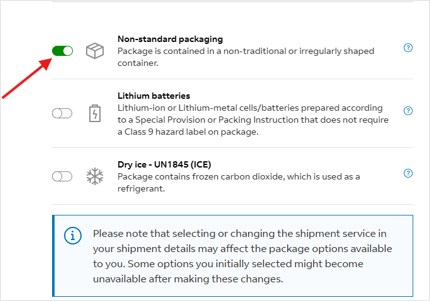
- Review the quote for any applicable Additional Handling, Oversize or Unauthorized Package charges and the corresponding demand surcharge.
Providing accurate shipment information can help you estimate potential charges, plan shipping costs and consider available packaging or shipping options.
Quoted charges are based on the information provided. Final charges are subject to verification and may change based on the package’s actual weight, dimensions, packaging and other characteristics.
For details on the applicable criteria, surcharge amounts and demand period, please visit the FedEx Demand Surcharge page.
As Vietnam Operations service levels continue to strengthen, effective August 14, 2026, the temporary demand control measure for shipments from Asia to Ho Chi Minh City (SGN) has been adjusted:
- The temporary service pause on FedEx International Economy® has been lifted. Transit time will be +1 day, similar to the current extensions made on FedEx International Priority® and FedEx International Priority® Freight.
- The temporary service pause on FedEx International Economy® Freight and FedEx® International Economy DirectDistribution will remain in place until further notice.
We will continue to keep you informed of the latest developments, and our teams remain committed to supporting your shipping needs with reliable services.
From July 1, 2026, FedEx Fiji will issue fiscal invoices to customers in accordance with the Fiji Revenue and Customs Service Tax Administration (Electronic Fiscal Device) Regulations 2017. These invoices will include a QR code-linked digital signature, allowing customers to verify the authenticity of their invoices through the Fiji Revenue and Customs Service website.
As part of our ongoing operational review and commitment to enhancing the customs clearance experience, we will be making updates to certain clearance-related fees and U.S. Inbound Processing Fee.
Ancillary clearance service fees, effective July 20, 2026
Effective July 20, 2026, Advancement Fee/ Disbursement Fee/ Duty and Tax Advancement Fee and Reimbursement on Delivery Fee (Duty Tax Handling Fee)/ Reimbursement on Delivery Fee / Duty Handling Fee will be adjusted. These fees apply since FedEx advance duties and taxes on behalf of customers during customs clearance except shipments where duties and taxes are set up for automatic credit card payment.
Please visit “Clearance Services and Related Fees” section of Surcharge and Other Information webpage to learn more.
Inbound Processing Fee, effective August 3, 2026
Effective August 3, 2026, the U.S. Inbound Processing Fee will be called the Inbound Processing Fee.
As of this date, the fee will also apply to all shipments destined to European Union (EU) member states: Austria, Belgium, Bulgaria, Croatia, Cyprus, Czech Republic, Denmark, Estonia, Finland, France, Germany, Greece, Hungary, Ireland, Italy, Latvia, Lithuania, Luxembourg, Malta, Netherlands, Poland, Portugal, Romania, Slovak Republic, Slovenia, Spain, and Sweden. The fee does not apply to shipments from one EU member state to another.
To learn more, please visit our Surcharge and Other Information webpage.
Operational recovery in Vietnam is progressing well, with shipment flows through clearance and last-mile delivery stabilizing as backlogs decline. As conditions continue to improve, service levels across the network are strengthening, enabling more customers to successfully send and receive shipments.
In line with these improvements, starting June 15, 2026, transit time will be updated as follows:
- From worldwide to Ha Noi: All transit time extensions will be removed
- From worldwide to Ho Chi Minh City: Temporary transit time extension will be reduced from +2 days to +1 day
Notes: Transit time extension is calculated in working days and applied to all services. Shipments picked up after the cut-off time will be processed on the next business day.
Our team remains focused on stabilizing operations and restoring service consistency as quickly as possible. We will continue to keep you updated.
1. Vietnam Transit Time Updates
Following our recent communications, FedEx has undergone an operational transition as part of our ongoing efforts to strengthen our capabilities in Vietnam. During this period, a combination of public holidays, elevated shipment volumes, and internal system adjustments has temporarily placed pressure on processing capacity.
Our teams are working around the clock to stabilize operations and restore normal service levels as quickly as possible. With steady progress across the network, the following updates will take effect on June 1, 2026:
- From Vietnam to worldwide: Transit times will resume to normal
- From worldwide to Ha Noi: Temporary transit time extension reduced from +2 days to +1 day
- From worldwide to Ho Chi Minh City: Temporary transit time extension reduced from +4 days to +2 days
Notes: Extension transit times are calculated in working days and applied to all services. Shipments picked up after the cut-off time will be processed on the next business day.
2. Ho Chi Minh City Warehouse Code Change
According to the latest official notice from the Express Customs Office, the warehouse code for Ho Chi Minh City will change from 02DSEDA to 06DSEDA, effective June 1, 2026.
- Export/Import shipments with declaration submission date before June 1, 2026, the declarations must use 02DSEDA
- Export/Import shipments with declaration submission date on or after June 1, 2026, the declarations must use 06DSEDA
If you use non-FedEx brokers for clearance, please ensure the correct warehouse code is applied when completing the Customs Declaration Form and Form 30 to avoid any delays.
Starting May 4, 2026, FedEx International Priority® Express (IPE)—our premium time‑definite international service—will expand its coverage to include Clark Field Pampanga, Philippines (postal code 2023) as a selectable destination, on top of the existing ones including Australia, Chinese Mainland, Hong Kong SAR, Japan, Singapore, Thailand.
This enhancement is part of our ongoing commitment to strengthening our express network and help businesses across Asia Pacific ship with greater speed, confidence, and reliability.
What This Means for You
With FedEx International Priority Express, you can enjoy:
- The fastest transit time riding on our premium air network
- 1–2 business‑day delivery to select destinations
- Committed noon delivery to key global markets
Whether you're shipping critical parts, essential documents, or time‑sensitive goods, IPE ensures your shipments arrive timely and reliably.
Ready to Ship Faster?
Experience the difference with FedEx International Priority Express and keep your business one step ahead. To learn more about the FedEx International Priority Express, contact your sales representative for more information.
To streamline payment reconciliation and ensure timely processing of payments, customers in Fiji are requested to submit payment remittance advice on the same day the payment is made. Remittances should include all mandatory information and be sent in the preferred format (PDF bank remittance advice). Acceptable alternatives include clear screenshots (JPG/JPEG/PNG/TIFF) or plain-text emails containing all required details. Include:
| FedEx Account Number | FedEx Invoice Number | Payment Amount (Local Currency) | Payment Date | Comments (if any) |
Dedicated Email for Remittance Submission:
- Send all payment remittance advice to your dedicated country-specific email address: FJ-paymentadvice@fedex.com
- Do not send remittance advice to other generic or shared email addresses, as this may cause delays or misplacement.
Impact of Delayed or Incomplete Submissions:
- Delayed reconciliation of your payment, leading to discrepancies and potential impacts to your account status.
- Temporary delays in order processing, delivery, or service provision may occur if payment cannot be verified.
- Additional administrative effort to trace and reconcile unmatched payments, potentially delaying payment verification.
Available Payment Methods (Fiji):
We support multiple convenient payment methods for Fiji, including:
- Electronic Funds Transfer (EFT)
For detailed guidelines and payment information, visit: fedex.com/fj
For questions or further clarification, please contact us at fscfj@fedex.com.
Shipping Regulatory Update
To address ongoing aviation security threats, U.S. Customs and Border Protection (CBP) enhanced its Air Cargo Advance Screening (ACAS) program on November 21, 2025.
Under this program, air carriers like FedEx are required to collect additional data for certain international shipments that move through our connected global network. While currently in a phased enforcement period, CBP recently announced that strict enforcement will begin May 1, 2027.
Additional data elements
Some of the enhanced ACAS data elements that FedEx will need to collect from shippers include the following mandatory data elements:
- Consignee email address
- Consignee phone number
- Ship to Party name and address (if different from Consignee)
- The shipper’s Verified Known Consignor registration number
In certain scenarios, additional data elements will need to be collected from shippers, including:
- Shipper email address
- Shipper phone number
- Biographic data
- The unmasked IP address or MAC address of the device used by the consignee to purchase the product and
- URL link; or
- SKU number
What you need to know
To ensure a seamless transition and avoid potential shipment delays, we recommend checking that your shipping systems capture the necessary data elements.
For more information behind these updates, please review the official Federal Register announcement and CBP’s Enhanced ACAS FAQs. We will continue to share updates as new details are available.
Effective from October 5, 2026, FedEx will introduce a Processing and Inspection Fee for low-value inbound shipments to Australia valued at AUD 1,000 or less that are selected by the Department of Agriculture, Fisheries and Forestry (DAFF) for inspection.
The fee amount is AUD 38 (excl. GST) per shipment and applies to FedEx’s additional operational activities required to manage DAFF‑directed inspections. These activities include identifying selected shipments, segregating and holding freight, coordinating inspection processes and performing associated handling tasks.
This fee is in addition to existing government-imposed fees, such as the DAFF Document Assessment Fee.
Shipments selected for inspection may include, but are not limited to, shipments containing plants, edible products, animal products, artwork, artificial flavourings and timber.
What is changing?
On October 1, 2026, US Customs and Border Protection (CBP) will increase certain user fees in accordance with 19 CFR 24.22. Included among the adjusted fees are the Merchandise Processing Fee (MPF) minimum and maximum limitations for formal entries:
- New minimum MPF is $34.58 (increased from $33.58)
- New maximum MPF is $670.86 (increased from $651.50)
CBP announced the updated fees in a general notice published on July 30, 2026, which identifies the customs user fee increases for fiscal year (fy) 2027 as required by the Fixing America’s Surface Transportation Act (FAST Act). The FAST Act mandates that various customs fees be increased for inflation each fiscal year based on Consumer Price Index (CPI) data.
Q&A
Q 1 – At what value thresholds do the MPF minimum and maximum fees for formal entries apply?
A 1 – The new minimum MPF fee of $34.58 will apply to all formal entry shipments valued $9,984.00 or less. The new maximum MPF fee of $670.86 will apply to all shipments valued $193,665 or higher.
Q 2 – Does this MPF increase apply for values between the minimum and maximum?
A 2 – No, the increase is applied only for the minimum and maximum fee assessment. All other MPF fees for shipments between those two values are calculated at the established ad valorem rate of 0.3464% (e.g., a shipment valued at $20,000 USD requires an MPF fee of $69.28 USD).
Q 3 – Are there any exemptions to the MPF assessment?
A 3 – Yes: CBP regulations in 19 CFR 24.23(c) provide a list of exemptions from the MPF. Examples include, but are not limited to:
- Articles entered under provisions of most preferential trade agreements (e.g., US-IL, US-CO, US-SG, USMCA, etc.)
- Articles entered under the Special Classification Provisions of Chapter 98 of the Harmonized Tariff Schedule of the United States (HTSUS)
- Products of insular possessions of the US under HTSUS General Note 3(a)iv
References
- General Notice - Customs User Fees to Be Adjusted for Inflation in Fiscal Year 2027 https://www.govinfo.gov/content/pkg/FR-2026-07-31/pdf/2026-15530.pdf
- 19 CFR 24.22 Fees for Certain Services https://www.ecfr.gov/current/title-19/chapter-I/part-24/section-24.22
- 19 CFR 24.23(c) Fees for Processing Merchandise - Exemptions and Limitations https://www.ecfr.gov/current/title-19/chapter-I/part-24/section-24.23
Get the latest updates and offers from FedEx by signing up for FedEx emails today.
https://page.message.fedex.com/emailpreferences/subscribe?locale=en-fj
Korea Customs Service (KCS) has introduced a registration system for Cross-Border E-commerce Business Identification Numbers to enhance the management of cross-border e-commerce shipments and facilitate efficient customs clearance. Accordingly, businesses handling cross-border e-commerce shipments in Korea are required to register for a Cross-Border E-commerce Business Identification Number through the dedicated registration system.
[Eligible Businesses]
- Overseas businesses operating an online marketplace and offering shipping services to Korea
- Domestic businesses operating an online marketplace or selling through an online marketplace that provide cross-border e-commerce purchasing agency or sales intermediary services
- Domestic and overseas businesses providing international forwarding services for cross-border e-commerce shipments destined for Korea
* Businesses previously registered with Korea Customs Service as purchasing agents or e-commerce businesses must also re-register through the new registration system.
[Key Date]
- August 28, 2026: Launch of the dedicated customs clearance platform for cross-border e-commerce
* The registered Cross-Border E-commerce Business Identification Number will be used in the dedicated customs clearance platform and will become a mandatory data element for import declarations and customs manifests.
[When Using the Dedicated Cross-Border E-commerce Declaration Format]
- After completing your UNIPASS registration, you must submit customer and transaction information to the Korea Customs Service through an API connection.
- FedEx must be able to receive your customer and transaction information in order to submit import declarations using the dedicated cross-border e-commerce declaration format.
* When the dedicated declaration format is used, import declarations can be accepted immediately upon cargo arrival, enabling faster customs clearance.
[When the Dedicated Cross-Border E-commerce Declaration Format Cannot Be Used]
- The business is not registered as a cross-border e-commerce business.
- Customer and transaction information cannot be submitted directly to the Korea Customs Service through an API connection.
* In these cases, shipments arriving in Korea will be treated as person-to-person (C2C) transactions, resulting in a significantly higher likelihood of customs inspection. In addition, the shipments will not be eligible for the list clearance (De Minimis) import declaration process and must instead undergo a formal import declaration. As a result, customs clearance and delivery may be delayed. However, please note that De Minimis process will still be permitted during the grace period provided by the Korea Customs Service until December 31, 2026.
[How to Register]
- Registration website: https://unipass.customs.go.kr/ecb/ovrs/index.do
The following documents are required for registration:
- Mail-Order Business Registration Certificate
- Internet Domain Registration Certificate
- Business Registration Certificate
- Corporate Registration Certificate (if applicable)
- National Tax and Customs Tax Payment Certificate, etc.
This new registration system is intended to improve the management of cross-border e-commerce businesses and establish a safer and more efficient customs clearance environment. To ensure smooth international shipping and customs clearance, eligible businesses are encouraged to complete their Cross-Border E-commerce Business Identification Number registration in advance and prepare the necessary API connection to submit customer and transaction information.
For more details, please visit KCS website (https://unipass.customs.go.kr/ecb/ovrs/index.do).
We remain fully committed to remitting applicable International Emergency Economic Powers Act (IEEPA) duties—and any accrued U.S. Treasury interest—to the customers who paid those charges as quickly as possible. To securely manage the complex reconciliation of millions of entries at no cost to our customers, we have launched a dedicated solution to improve transparency and expedite processing.
The IEEPA tariff refund portal is now live
Access our new customer portal by entering your shipment details to verify if FedEx has received your refund from the U.S. Treasury, including the amount, interest, and receipt date.
Within the portal, customers will be able to validate their contact information and, if necessary, opt in to share limited shipment and refund data with our trusted, secure vendor partners. This data will be handled according to FedEx’s Data Protection Policy and used only for the purpose of reconciling accounts and processing refunds.
We anticipate that disbursement of initial refunds will begin on or about August 10 (Note: Customers from whom consent is requested but choose to decline data sharing will still receive refunds, but should expect a longer delivery timeline, due to manual processing.)
CBP refund phasing update
Because U.S. Customs and Border Protection (CBP) has established phases during which certain entries are eligible for submission, timing depends on specific entry status of your shipments:
- Phase 1 (Ongoing): The U.S. Treasury continues to send refunds for eligible unliquidated entries and entries within 80 days of liquidation to FedEx on a rolling basis.
- Phase 2 (Ongoing): Covers entries flagged by the importer at the time of entry for reconciliation.
- Phase 3 (Upcoming - Target July 31): Covers finally liquidated and complex entries. Because eligibility for Phase 3 remains subject to court review, we strongly encourage you to discuss eligibility with your legal counsel.
We appreciate your continued patience as we navigate the refund process to return your funds to you swiftly.
DOWNLOAD THE USER GUIDE (Updated on September 21, 2026)
The United States imposed additional tariffs ranging from 10% to 12.5% on imported products of 60 economies under Section 301 of the Trade Act of 1974, which became effective on July 24, 2026. The new Section 301 tariffs became effective on the same date that the temporary Section 122 balance-of-payments tariffs expired. These Section 301 duties apply broadly based upon a product’s country of origin with specific exemptions for certain goods.
What is changing?
On July 23, 2026, the Office of the United States Trade Representative (USTR) announced this Section 301 tariff action to enact additional duties on a wide range of global imports. US Customs and Border Protection (CBP) subsequently issued Cargo Systems Messaging Service (CSMS) #69326983 to provide implementation instructions, which included the applicable Harmonized Tariff Schedule of the United States (HTSUS) numbers and available exemptions.
Under the new rules, affected goods will be subject to an additional 10% or 12.5% duty rate depending on their country of origin. For certain origin countries, the tariff rate is applied net of the product’s existing most-favored-nation (MFN) duty rate.
These Section 301 duties apply to products of the specified countries entered for consumption, or withdrawn from warehouse for consumption, on or after 12:01 am eastern time on July 24, 2026.
Impacted economies and tariff rates
The additional duties must be reported using Chapter 99 HTSUS subheadings ranging from 9903.05.20 to 9903.05.84. The specific tariff rate is dependent upon a product's country of origin:
- 10% duty rate: applies to goods originating in Argentina, Bangladesh, Cambodia, Canada, Ecuador, El Salvador, Guatemala, Honduras, India, Indonesia, Jordan, Malaysia, Mexico, Pakistan, Sri Lanka, Trinidad and Tobago, and the United Kingdom.
- 12.5% duty rate: applies to goods originating in Algeria, Angola, Australia, the Bahamas, Bahrain, Brazil, Chile, China, Colombia, Costa Rica, Dominican Republic, Content intended for FedEx customers only Egypt, Guyana, Hong Kong, Iraq, Israel, Kazakhstan, Kuwait, Libya, Morocco, New Zealand, Nicaragua, Nigeria, Norway, Oman, Peru, the Philippines, Qatar, Russia, Saudi Arabia, Singapore, South Africa, Thailand, Türkiye, United Arab Emirates, Uruguay, Venezuela, and Vietnam.
- 10% net of MFN rate (capped at 10%): applies to goods originating in the European Union and Taiwan. If the product's existing MFN tariff is less than 10%, the Section 301 tariff is applied so that the sum of the MFN and Section 301 tariff equals 10%. If the product's MFN tariff is 10% or greater, the additional Section 301 duty is zero.
- 12.5% net of MFN rate (capped at 12.5%): applies to goods originating in Japan, South Korea, and Switzerland. If the product's existing MFN tariff is less than 12.5%, the Section 301 tariff is applied so that the sum of the MFN and Section 301 tariff equals 12.5%. If the product's MFN tariff is 12.5% or greater, the additional Section 301 duty is zero.
Exemptions
Certain commodities and shipment types are exempt from these additional tariffs, which are processed using specific Chapter 99 HTSUS subheadings (9903.05.85 through 9903.06.21). Notable exemptions include:
- In-transit goods (9903.05.85): articles loaded onto an ocean vessel at the port of loading and in transit to the US prior to the effective date, provided they are entered for consumption before 12:01 am eastern time on July 28, 2026.
- Aviation (9903.05.88): civil aircraft, civil aircraft engines, and their parts and components classified under HTSUS Chapter 88 or qualifying civil aviation provisions.
- Healthcare (9903.05.89): active ingredients, chemical compounds, and finished products used in pharmaceutical applications.
- Trade agreements (9903.05.93 & 9903.05.95): specific goods entering duty-free under the United States-Mexico-Canada Agreement (USMCA) and select textiles or apparel under the Dominican Republic-Central America-United States Free Trade Agreement (CAFTA-DR).
- Chapter 98: imports properly entered under HTSUS Chapter 98. However, this exemption excludes goods entered under subheadings 9802.00.40, 9802.00.50 and 9802.00.60 (articles exported for repairs or alterations) as well as 9802.00.80 (articles assembled abroad). For these excluded items, the 10% or 12.5% Section 301 duties will still apply to the value of the repairs, alterations, or processing performed.
- Existing Section 232 tariff items (9903.05.90): goods already subject to active Section 232 duties, which include:
- Metals: articles of steel, aluminum, or copper (and their derivatives).
- Transportation: passenger vehicles (sedans, SUVs, minivans, light trucks) and their parts.
- Technology & materials: semiconductor articles and select wood products.
- General products (9903.05.86 & 9903.05.87): standard commodities described under US note 52(b) and 52(c) of the tariff schedule, which includes specific exemptions for agricultural goods (e.g., certain seeds, tropical fruits) and raw materials where tariffs could cause supply shortages.
- Donations (9903.05.91): articles donated by US entities intended to relieve human suffering (e.g., emergency food, clothing, and basic medicines).
- Informational materials (9903.05.92): media items, including books, publications, films, posters, photographs, compact disks, artworks, and news wire feeds.
- Country-specific exemptions (9903.05.97 through 9903.06.21): narrow, country specific exemptions for unique domestic specialties. Content intended for FedEx customers only
For a complete list of all authorized exemptions and their corresponding Chapter 99 HTSUS subheadings, refer to CBP CSMS #69326983 linked in the Resources section below.
Q&A
Q 1: How do I determine if my product is subject to the new Section 301 tariffs?
A 1: Tariff applicability is determined by two factors: the product's country of origin and its HTSUS classification. If a product has an impacted country of origin and is classified under an HTSUS provision covered by this action that does not qualify for any of the specific exemptions (e.g., pharmaceutical or civil aviation), it is subject to the additional 10% or 12.5% Section 301 duty. Shippers are encouraged to review the full list of impacted economies and HTSUS subheadings detailed in the USTR Notice and CBP CSMS #69326983 linked below.
Q 2: How does the "net of MFN" tariff calculation work for origins like the EU, Taiwan, Japan, South Korea, and Switzerland?
A 2: For origins subject to a net-MFN rate, the Section 301 tariff acts as a cap on the total import duty. For the EU and Taiwan, the total duty (existing MFN rate + Section 301 rate) is capped at 10% (e.g., if an EU-origin product has an existing MFN rate of 3%, a Section 301 duty of 7% will be applied to reach the 10% cap). If the existing MFN rate is already 10% or higher, the additional Section 301 duty is 0%. For Japan, South Korea, and Switzerland, the total duty is capped at 12.5% using the same calculation methodology.
Q 3: What is required on shipping documentation if my product qualifies for an exemption?
A 3: To successfully claim an exemption, shippers must note the specific Chapter 99 HTSUS exemption subheading (e.g., 9903.05.89 for pharmaceuticals) on the commercial invoice alongside the standard Chapter 1-97 commodity code. Shippers must also include any relevant certificates or documentation necessary to substantiate the claim to CBP.
Q 4: Are there exemptions for goods imported under Chapter 98, such as items exported for repair or alteration?
A 4: While standard Chapter 98 imports are generally exempt from Section 301 duties, specific exceptions apply. Under the new guidelines, goods entered under HTSUS subheadings 9802.00.40, 9802.00.50, and 9802.00.60 (articles exported for repairs or alterations) and 9802.00.80 (articles assembled abroad) are not exempt. For these items, the Section 301 duties will be assessed on the value of the repairs, alterations, or foreign processing.
Q 5: How can I determine if there is a country-specific exemption for my product?
A 5: Country-specific exemptions are very narrow and cataloged under HTSUS subheadings 9903.05.97 through 9903.06.21. Shippers should consult the USTR Notice and CBP CSMS #69326983 linked below to review the exact list of excluded commodities by country. To qualify, a product must precisely match both the specified origin country and exact Chapter 1-97 HTSUS classification outlined in the exemption.
Q 6: Do the new Section 301 tariffs stack on top of existing Section 232 tariffs on metal products (such as steel, aluminum, and copper) or automobiles?
A 6: No, these duties do not stack. Under CBP guidelines in CSMS #69326983, goods that are already subject to active Section 232 tariffs and entered under their corresponding Chapter 99 provisions are explicitly exempt from these additional Section 301 tariffs. Importers of Content intended for FedEx customers only these goods will continue to pay only the established Section 232 duty rates and do not need to layer the new 10% or 12.5% Section 301 tariffs on top.
Q 7: My shipment was already in transit before the July 24th effective date. Will it be subject to the new duties?
A 7: A shipment will only be exempt under HTSUS subheading 9903.05.85 if it meets two strict timing criteria: it must have been loaded onto an ocean vessel at the port of export and been in transit to the US prior to 12:01 am eastern time on July 24, 2026, and it must be officially entered for consumption in the US before 12:01 am eastern time on July 28, 2026.
Resources
US Customs and Border Protection (CBP) CSMS #69326983, published July 23, 2026
The EU is introducing an EU-wide Handling Fee on low-value consignments (below EUR 150), as follows:
- A fee per item released for free circulation (imported), or;
- A reduced fee if the importer at the time of release for free circulation is a Trust and Check trader operating a customs warehouse for distance sales. Trust and Check is a new trusted trader concept introduced by the EU customs reform that builds on the AEO status.
The amounts are yet to be defined. The handling fee will be collected by national customs for the services rendered for releasing for free circulation goods sold in distance sales. It will be non-refundable.
Timing:
This measure has been adopted as part of the EU’s Customs Reform. Implementation is anticipated by November 1, 2026.
In parallel, some EU Member States have moved to impose national import handling fees on low-value goods, ahead of the planned EU customs reform.
- Romania has implemented a “national logistics tax” of 25 RON (approx. €5) for all B2C shipments below 150 EUR dispatched from outside the EU and delivered in Romania, regardless of the entry scheme. The national logistics tax applies from January 1, 2026. There is currently no information in Romanian legislation indicating that the national logistics tax would be removed once an EU-wide handling fee is introduced.
- Italy included a €2 handling fee for low-value imports in its 2026 budget law, which has been adopted and effective as of January 1, 2026. After several suspensions, on June 22, 2026, new postponement of the fee on October 1, 2026, was decided by the government.
- France applied a €2 fee per line of the declaration (customs administration fee) for all shipments cleared in the simplified clearance from March 1 to June 30, 2026. The French fee was suspended on July 1, 2026.
We are monitoring the developments closely and will provide updates as more information becomes available and certain.
Useful resources:
Council of the EU – Customs: Council Agrees to Levy Customs Duty on Small Parcels as of July 1, 2026: https://www.consilium.europa.eu/en/press/press-releases/2025/12/12/customs-council-agrees-to-levy-customs duty-on-small-parcels-as-of-1-july-2026
Council of the EU – Council gives final green light to new customs duty rules for small parcels: https://www.consilium.europa.eu/en/press/press-releases/2026/02/11/council-gives-final-green-light-to-new customs-duty-rules-for-small-parcels/
Council of the EU - EU customs: Council and Parliament agree on landmark reform: https://www.consilium.europa.eu/en/press/press-releases/2026/03/26/eu-customs-council-and-parliament agree-on-landmark-reform/
European Commission – Commission welcomes historic agreement to reform EU Customs Union Page 3 of 18 Service & Regulatory impacts (as of July 6, 2026): https://ec.europa.eu/commission/presscorner/detail/en/ip_26_73 5
European Parliament – Deal reached on Union Customs Code reform: https://www.europarl.europa.eu/news/en/press-room/20260323IPR38815/deal-reached-on-union-customs code-reform
Effective July 1, 2026, low-value B2C shipments to the EU are subject to a €3 customs duty per declaration line and new product data requirements. To help you stay compliant and minimize disruption, we provide a range of tools and step-by-step guides to support your shipping and customs clearance processes.
FedEx Import Tool
A free, fast, and user-friendly solution for managing the clearance of your import shipments.
- View the clearance status of your import shipments
- Receive advance notice of upcoming import shipments
- Stay informed about pending clearance actions
- Submit customs clearance documents and instructions directly to us
- Download clearance-related documents
- Pay duties and taxes
When action is required, you'll receive an email or mobile notification with the necessary next steps. Stay connected and watch for our messages to help keep your shipments moving smoothly.
Product Identifier (PID) Guide
A step-by-step guide to help you enter Product Identifier (PID) information for your shipments in FedEx Ship Manager™ at fedex.com and on your commercial invoice.
A guide to help you enter the IOSS number for your shipments in various FedEx shipping tools.
Updated Regulatory API and related Ship API which enable you to store and provide per-product regulatory compliance data alongside customs declarations
Understand the EU Customs Changes
Visit our dedicated webpage for the latest information, tools, and guidance.
Are you ready for the EU customs changes?
As of July 1, 2026, the European Union has removed the de minimis exemption for low-value imports. As a result, goods valued at €150 or less entering the EU may be subject to new customs charges (in addition to the existing VAT).
What is the financial impact?
For eligible B2C* shipments, with an intrinsic value of €150 or less, a new €3 customs duty may apply for each line on the customs declaration.
The customs declaration for a single shipment may contain multiple declaration lines depending on the products being shipped and their tariff classification. As a result, multiple €3 duty may apply for the same shipment.
In addition to the new customs duty scheme, FedEx is introducing some pricing updates to offset the additional operational and customs clearance activities required as more shipments become subject to EU customs processing.
* By European Commission definition, B2C shipments are shipments sent to non-VAT-registered recipients in destination country
Here's a breakdown to help you understand the full cost impact:
Charged by the EU
| Charge | Amount | Effective date |
|---|---|---|
| NEW: customs duty | €3 per declaration line | July 1, 2026 |
| AS-IS: VAT | Varies per country | Already in effect |
| NEW: EU handling fee | €2 per declaration line | Expected November 1, 2026 |
Charged by FedEx
As part of our ongoing operational review and commitment to enhancing the customs clearance experience, we will be making updates to certain clearance-related fees and U.S. Inbound Processing Fee.
Ancillary clearance service fees, effective July 20, 2026
Effective July 20, 2026, Advancement Fee/ Disbursement Fee/ Duty and Tax Advancement Fee and Reimbursement on Delivery Fee (Duty Tax Handling Fee)/ Reimbursement on Delivery Fee / Duty Handling Fee will be adjusted. These fees apply since FedEx advance duties and taxes on behalf of customers during customs clearance except shipments where duties and taxes are set up for automatic credit card payment.
Please visit “Clearance Services and Related Fees” section of Surcharge and Other Information webpage to learn more.
Inbound Processing Fee, effective August 3, 2026
Effective August 3, 2026, the U.S. Inbound Processing Fee will be called the Inbound Processing Fee.
As of this date, the fee will also apply to all shipments destined to European Union (EU) member states: Austria, Belgium, Bulgaria, Croatia, Cyprus, Czech Republic, Denmark, Estonia, Finland, France, Germany, Greece, Hungary, Ireland, Italy, Latvia, Lithuania, Luxembourg, Malta, Netherlands, Poland, Portugal, Romania, Slovak Republic, Slovenia, Spain, and Sweden. The fee does not apply to shipments from one EU member state to another.
To learn more, please visit our Surcharge and Other Information webpage.
NOTE: The tables above provide an overview of potential charges and is not intended to represent a sample cost calculation. Import duties and other taxes (such as VAT) are imposed by the EU and governmental authorities, while FedEx charges only Disbursement Fee and Inbound Processing Fee. Actual landed costs will vary depending on factors such as destination-country VAT rates, applicable waivers or discounts, shipment characteristics, and other variables, meaning not all charges shown will apply to every shipment.
Free Trade Agreements
Shipments covered by a free trade agreement may qualify for duty relief, provided the goods are not sold under the IOSS scheme. If your shipment falls under a free trade agreement and is sold via Import One Stop Shop (IOSS), a €3 customs duty will apply per declaration line
Avoid surprises: confirm billing details before you ship
IncoTerms® define the responsibilities agreed between buyer and seller, but they do not determine how FedEx bills transportation charges, duties, taxes, and fees.
When creating a shipment in FedEx tools, make sure you clearly select the appropriate billing terms and specify:
- Who pays transportation charges
- Who pays duties and taxes
- The correct FedEx account number for each payor
If duties and taxes are billed to the recipient, ensure the recipient has agreed to pay, their email address is provided, and their account details are accurate. This helps us collect payment efficiently and avoid customs clearance delays.
Additional tip: When making a payment by bank transfer, include your air waybill (AWB) number as a payment reference. This helps us allocate your payment more quickly and accurately.
Returns and refunds
If goods are returned after importation, duties and taxes paid may not always be refundable. We also recommend considering this when planning your pricing, return policies, and customer communications.
Learn more
FedEx has more than 50 years of experience helping businesses navigate global trade and customs regulations. Visit our dedicated page to learn more and prepare for the upcoming changes.
1. What is the status of my IEEPA refund, and when and how will it be issued?
As previously announced, when the CAPE portal opened in April, FedEx began submitting Declarations for those Phase 1 shipments where we served as broker. We did so to help our customers maximize the number of eligible submissions before applicable liquidation deadlines. On May 11, FedEx began receiving government-issued refunds for entries where we were the IOR or where we were designated by the IOR as the notify party on a customer-submitted CF4811.
We recognize that customers are eager to understand when refunds will be disbursed. FedEx remains fully committed to remitting all applicable duties – along with any accrued interest received from the U.S. Treasury – as quickly as possible. At the same time, we are managing over 20 million entries with IEEPA duties across hundreds of thousands of accounts. We are diligently working through necessary validation and financial reconciliation processes to ensure accuracy and safeguard against fraud.
To support this effort, FedEx has invested heavily in all available resources to build a secure, precise solution. We are doing so at no cost to our customers and are absorbing the associated operational expenses.
What to Expect:
To improve transparency, FedEx will launch a customer portal by July 10. This tool will allow customers to enter shipment details and verify whether a refund has been received by FedEx, including the associated money and interest and when the refund was received.
Within the portal, customers will have the option to consent to sharing limited shipment and refund data with trusted vendor partners solely for the purpose of reconciliation and processing refunds. As portal functionality expands after July 10, customers who verify their accounts and opt in to data sharing will be prioritized for disbursement. Customers who decline data sharing will still receive refunds, though on a longer timeline based on available internal resources.
We anticipate that those initial refunds received by FedEx will begin to be disbursed to our customers on or about August 10. Refunds will continue to be disbursed on a rolling basis.
It is important to note that FedEx has not yet received refunds for all shipments subject to IEEPA tariffs or even for all entries submitted during Phase 1. During Phase 1, U.S. Customs and Border Protection (CBP) limited eligibility to unliquidated entries and those within 80 days of liquidation. Phase 1 refunds continue to be sent by the U.S. Treasury to FedEx on a rolling basis. CBP has not yet initiated Phase 2 or Phase 3 of the refund process; however, CBP is targeting June 29 as the date it will begin accepting Phase 2 submissions and July 31 for Phase 3 submissions. Phase 2 will cover only those entries flagged for reconciliation for which the reconciling entry has not yet been filed. Who will be eligible for refunds during Phase 3, which covers finally liquidated entries and other complex entries, remains uncertain and is being addressed in the courts. If you are an importer of record, we encourage you to discuss eligibility for Phase 3 refunds with your legal counsel.
We understand the challenges this process has created for our customers. FedEx remains dedicated to providing transparency at every step and genuinely appreciates the continued patience as we work through this complex regulatory environment.
2. What is the latest status for Phase 2 Filing?
FedEx continues to support you with International Emergency Economic Powers Act (IEEPA) duty requirements and upcoming U.S. Customs and Border Protection (CBP) refund phases. CBP anticipates that it will begin accepting Phase 2 CAPE filings on June 29. Phase 2 of the refund process covers entries that were flagged for reconciliation at the time of entry. These filings remain subject to CBP processing timelines.
To streamline processing and minimize your administrative burden, FedEx will proactively submit Phase 2 CAPE filings on behalf of eligible Importers of Record beginning July 7.
3. How do I opt out of FedEx submitting my Phase 2 CAPE filings?
If you prefer to manage your own Phase 2 CAPE filings, you must opt out no later than July 6th by contacting CAPE_CustSelfFiling@fedex.com. Your request must include your Company Name, FedEx Account Number, EIN/IOR Number, and representative contact information. Please note, if you already notified FedEx of your desire to opt out in connection with Phase 1 submissions, that request will be honored for all subsequent phases and you do not need to reach out again.
Prepare now to avoid delays and disruption to your deliveries.
FedEx is here to help you get ready.
What’s changing?
From July 1, 2026:
- The de minimis exemption ends for low-value goods imported into the EU
- A new €3 customs duty applies to B2C goods valued at €150 or less
- Additional product data shall be provided for customs clearance
A reminder of the details
All imports into the EU with an intrinsic value of €150 or less will be subject to a €3 duty for each line of the customs import declaration (which can contain one or more items, depending on the tariff classification).
There are a few exceptions:
- For B2B VAT registered recipients, standard duty rates will be applied
- For free trade agreement shipments:
- Not sold under the Import One Stop Shop (IOSS) scheme, duty relief can be applied.
- Sold under the IOSS scheme, the €3 customs duty will be applied per line of the declaration).
VAT rules for imports into the EU remain unchanged.
Additional data requirements
Product Identifiers are a set of codes used by manufacturers, sellers, platforms, and marketplaces to identify their products.
From July 1, 2026, for B2C shipments* imported into the EU regardless of value (with the exception of B2B VAT registered imports), three codes shall be provided to the customs authorities during the clearance process.
- Merchant Product Identifier
- Non-standardised Manufacturer Product Identifier
- Standardised Manufacturer Product Identifier (only if it exists)
We strongly recommend adding the three product identifiers from July 1, 2026 onwards to help ensure smooth clearance for low-value shipments arriving the EU in preparation for the November 1, 2026 enforcement, following guidance from the European Union authorities.
* By European Commission definition, B2C shipments are shipments sent to non-VAT-registered recipients.
This data requirement does not apply to B2B VAT-registered imports.
Providing your recipient's email address is also critical to ensure timely payment of duties, taxes, and any applicable FedEx fees at import.
Get ready now
FedEx acts as the customs broker at the time of import into the EU customs territory. If we do not have the right information in compliance with the new regulation relating to products sold in the EU, your shipments will not be cleared by the national Customs Authorities, and your customers will not receive their goods.
Review your processes and systems today to ensure you provide complete and accurate product data and understand how duties and taxes apply to your shipments. With over 50 years of experience in global trade and regulations, FedEx is here to support you.
Prepare now to avoid delays and disruption to your deliveries.
FedEx is here to help you get ready.
What’s changing?
From July 1, 2026:
- The de minimis exemption ends for low-value goods imported into the EU
- A new €3 customs duty applies to B2C goods valued at €150 or less
- Merchant Product Identifier, Non-standardised Manufacturer Product Identifier, and Standardised Manufacturer Product Identifier (only if it exists) will be required. We strongly recommend adding the three product identifiers from July 1, 2026 onwards to help ensure smooth clearance for low-value shipments arriving the EU in preparation for the November 1, 2026 enforcement, following guidance from the European Union authorities.
A reminder of the details
All imports into the EU with an intrinsic value of €150 or less will be subject to a €3 duty for each line of the customs import declaration (which can contain one or more items, depending on the tariff classification).
There are a few exceptions:
- For B2B VAT registered recipients, standard duty rates will be applied
- For free trade agreement shipments:
- Not sold under the Import One Stop Shop (IOSS) scheme, duty relief can be applied.
- Sold under the IOSS scheme, the €3 customs duty will be applied per line of the declaration).
VAT rules for imports into the EU remain unchanged.
Additional data requirements
Product Identifiers are a set of codes used by manufacturers, sellers, platforms, and marketplaces to identify their products.
From July 1, 2026, for consumer goods imported into the EU with an intrinsic value not exceeding €150, three codes shall be provided to the customs authorities during the clearance process.
- Merchant Product Identifier
- Non-standardised Manufacturer Product Identifier
- Standardised Manufacturer Product Identifier (only if it exists)
We strongly recommend adding the three product identifiers from July 1, 2026 onwards to help ensure smooth clearance for low-value shipments arriving the EU in preparation for the November 1, 2026 enforcement, following guidance from the European Union authorities.
This data requirement does not apply to B2B VAT-registered imports.
Here’s what you need to confirm with your customers in EU customs territories:
- Ask whether they are VAT-registered and ensure correct documentation
- Guarantee that the recipient’s VAT registration status is both shared with us and clearly reflected in our systems and on the commercial invoice.
- Agree upfront who pays duties and taxes, to avoid unexpected costs or delays
- Make sure IncoTerms© are aligned with the FedEx shipping terms - if you don’t select “Bill to Shipper”, duties are automatically assigned as “Bill to Recipient”
- Set clear expectations on returns - duties/taxes may not be refundable
- Update checkout transparency -review terms and make duties/taxes responsibilities explicit
Working together with your customers will improve transparency and avoid both surprises and unnecessary delays.
Providing your recipient's email address is also critical to ensure timely payment of duties, taxes, and any applicable FedEx fees at import.
Get ready now
FedEx acts as the customs broker at the time of import into the EU customs territory. If we do not have the right information in compliance with the new regulation relating to products sold in the EU, your shipments will not be cleared by the national Customs Authorities, and your customers will not receive their goods.
Review your processes and systems today to ensure you provide complete and accurate product data and understand how duties and taxes apply to your shipments. With over 50 years of experience in global trade and regulations, FedEx is here to support you.
On February 20, 2026, the United States Supreme Court ruled that the tariffs issued under the International Emergency Economic Powers Act (IEEPA) are unlawful. We understand that this news has prompted questions about previously assessed duties and taxes. We are committed to helping our customers navigate the regulatory environment and providing updates when we have them. No other duties or tariffs are impacted by the Supreme Court’s ruling.
Our intent is straightforward: if refunds are issued to FedEx, we will issue refunds to the shippers and consumers who originally bore those charges. FedEx is prioritizing its Phase-1 submissions based on liquidation dates. FedEx is committed to working expeditiously to issue refunds for IEEPA tariffs paid to its customers for whom it served as customs broker as soon as it begins receiving refunds from CBP.
We are committed to transparency and will communicate clearly as additional direction becomes available from the U.S. government and the court.
Section 122 Clarification:
On May 7, 2026, the U.S. Court of International Trade (CIT) ruled that the temporary tariffs imposed under Section 122 of the Trade Act of 1974 are unlawful because the economic conditions required for implementation were not met. This opinion only applies to two businesses and the State of Washington, importers who brought the suit, and the decision has already been appealed by the government. Tariffs imposed under Section 122 are separate and distinct from IEEPA tariffs. This decision does not impact the IEEPA refund process, and Section 122 duties are not currently eligible for IEEPA tariff refunds. At this time, FedEx will continue to assess and collect Section 122 tariffs in accordance with current government guidance, unless and until further direction is issued by U.S. authorities.
Below are answers to some common questions regarding the refund process:
1. When did FedEx start submitting refund declarations? FedEx began submitting refund declarations to CBP on behalf of all customers who originally bore those charges for FedEx-brokered shipments on April 20, the day that the CAPE system opened for Phase-1 entries.
2. How is FedEx prioritizing filings? FedEx is prioritizing the filing of entries by liquidation date. Please note that not all entries with IEEPA tariffs attached will be accepted by CBP during Phase-1 of its refund process. We appreciate our customers’ patience as it will take time for all entries to be submitted.
3. Can FedEx provide entry reports or refund estimates? FedEx is unable at this time to provide customers with entry reports that could be used to reasonably estimate refunds because the duty billing and payment records reside outside our entry system. Any report we could provide now would be incomplete and would not accurately estimate refunds or determine who ultimately paid the tariffs.
4. When will I receive my refund? We don’t have an exact timeline yet. CBP has said it expects to issue refunds 60–90 days after a declaration is accepted, unless further review is needed. FedEx will work quickly to issue refunds once we receive them from CBP.
5. Is FedEx charging a fee to submit declarations or process refunds? No. FedEx is not charging any service fee for the submission of declarations or processing of refunds. Our priority is to ensure a smooth and efficient refund process for everyone.
6. Where can I find the latest updates? Get current information on our international tariffs page. You can also get more details on the CBP’s IEEPA Duty Refunds page.
7. Will FedEx apply for IEEPA refunds on behalf of customers who used FedEx as the Importer of Record (IOR)? Yes. FedEx has submitted refund applications for customers where it acted as the customs broker, regardless of the Importer of Record (IOR) status.
For Phase 1 eligible entries, FedEx has filed the necessary declarations at no additional charge to help ensure timely acceptance and processing of refunds.
8. Will FedEx apply for IEEPA refunds on behalf of customers who are their own IOR but used FedEx as the customs broker? Yes. FedEx has applied for refunds for customers who acted as their own IOR, provided that FedEx served as the customs broker.
Declarations for Phase 1 eligible entries have been filed in these cases. Requests from customers to delay filing (submitted prior to May 1, 2026) were honored.
9. Will FedEx apply for IEEPA refunds for customers who used FedEx as IOR but have Automated Clearing House (ACH) set up to pay duties directly to CBP? Yes. FedEx has applied for refunds regardless of ACH payment arrangements.
Please note that customers cannot have an ACH duty payment setup with CBP if FedEx is designated as the Importer of Record.
10. Will FedEx apply for IEEPA refunds for customers who are their own IOR and have Automated Clearing House (ACH) set up to pay CBP directly (with FedEx acting solely as broker)? Yes. FedEx has also applied for refunds in these scenarios, unless the customer requested a delay in filing prior to May 1, 2026.
Refund disbursement depends on how the shipment was filed with CBP:
- If FedEx was listed as the notify party (CBP Form 4811), FedEx will receive the refund and subsequently disburse it to the customer.
- If the customer was both the IOR and the notify party, the refund will be issued directly by CBP, provided the customer has an ACH Refund account set up.
- If the customer does not have an ACH Refund account, the refund may not be automatically disbursed and could remain pending. In such cases, customers should contact CBP directly for guidance on next steps.
For visibility on refund status, CBP offers several Automated Commercial Environment (ACE) reports that importers and brokers can use to monitor CAPE refund claims, including liquidation and refund activity.
For more information, please refer to https://www.cbp.gov.
11. Will FedEx apply for IEEPA refunds for customers who use a Broker Select Option (BSO)? No. FedEx has not applied for refunds for shipments processed under a Broker Select Option (BSO), as FedEx was not the broker of record for those transactions.
FedEx only filed declarations for Phase 1 eligible entries where it acted as the customs broker.
Customers can rest assured that the FedEx team is working to secure a refund of IEEPA tariffs on behalf of all customers who originally bore those charges for FedEx-brokered shipments. Thank you for your patience as we work through this process.
Sincerely,
The FedEx team
Customs duty rules are changing for low-value imports to EU (with a value up to €150) from July 1, 2026.
The changes bring in a requirement to submit additional data elements: for each product imported into the EU customs territory in a shipment with an intrinsic value not exceeding €150, Product Identifier (PID) details will be needed. This change does not apply to B2B VAT-registered imports.
Until this information is provided, your goods cannot be cleared by the Customs Authorities and delivered by FedEx.
Learn more about Product Identifier (PID) and understand what actions you need to take at fedex.com.
What are Product Identifiers?
Product Identifiers are a set of codes used by manufacturers, sellers, platforms and marketplaces to identify their products.
From July 1, 2026, for consumer goods imported into the EU with an intrinsic value not exceeding €150, it’s mandatory to submit three codes to the customs authorities during the clearance process.
Merchant Product Identifier – the merchant’s unique code to identify goods, usually the SKU (Stock Keeping Unit), item code or product code.
Non-standardised Manufacturer Product Identifier – a manufacturer or product supplier’s unique code, assigned to an individual product.
Standardised Manufacturer Product Identifier (only if it exists) - assigned by a global industry standard body with a bar code when the manufacturer’s product meets global standards from a governing body. The barcode is the same for every retailer selling the exact product.
We strongly recommend adding the three product identifiers from June 15, 2026 onwards, to help ensure smooth clearance for low-value shipments arriving in the EU on or after July 1.
What do I need to do?
From June 15, 2026, provide the codes mentioned above to FedEx on the commercial invoice. Our shipping systems are being enhanced to support this requirement, with more details to follow.
In addition to all mandatory requirements, providing the recipient's email is critical in ensuring smooth shipping and timely payment of duties, taxes, and any FedEx ancillary fees due at the time of import.
What shipments are applicable?
Any goods sold direct to consumers and through marketplaces, with an intrinsic value not exceeding €150, imported into the EU. B2B VAT registered imports are not impacted.
Why does it matter?
FedEx acts as the customs broker at the time of import into the EU customs territory. If we do not have the right information in compliance with the new regulation relating to products sold in the EU, your shipments will not be cleared by the national Customs Authorities and your customers will not receive their goods.
Get more details
Stay informed with the latest updates and tips at fedex.com.
Background
The U.S. Consumer Product Safety Commission (CPSC) regulates many common household and consumer products. Currently, importers of CPSC regulated products must maintain certificates of compliance and provide them to CPSC or U.S. Customs and Border Protection (CBP) upon request.
In October 2024, the CPSC began a voluntary electronic filing (eFiling) pilot to allow certificate of compliance information to be filed via CBP’s Automated Commercial Environment (ACE) entry filing system. CPSC states that eFiling helps reduce holds and examinations on compliant products.
What’s new?
Effective July 8, 2026, electronic filing (eFiling) will be mandatory for products imported into the United States that are regulated by the U.S. CPSC. Importers of CPSC regulated products will be required to provide Certificate of Compliance data with their shipping documentation, so that the information can be electronically transmitted via the CPSC Participating Government Agency (PGA) message set in ACE at the time of entry into the United States.
The full CPSC PGA message set will require importers to provide seven Certificate of Compliance data elements for each product imported. To streamline the process, importers may pre-file information about the product in CPSC Product Registry. Products pre-registered in the CPSC Product Registry qualify for an abbreviated filing method, whereby only three data elements are required under the reference (abbreviated) PGA message set.
Failure to provide the required information could result in entry delays, shipment holds, examinations, or additional documentation requests. Recent reports indicate that completion of the CPSC Product Registry process may take some time, so importers who are interested are encouraged to begin the process as soon as possible to avoid potential clearance delays.
Please note that for trade partners who are not the importer, CPSC product registration is the responsibility of the direct supplier or shipper. FedEx does not register products on behalf of customers.
We will share more information regarding implementation details as it becomes available to help you stay informed and support you along your shipping journey with FedEx.
Frequently Asked Questions
Q1: What products are affected by the new CPSC eFiling requirements?
The new requirement applies to finished consumer products imported into the U.S. and regulated by the U.S. CPSC that require certification under 16 CFR Part 1110 (CPSC only regulates finished products). Examples of affected product categories include, but are not limited to:
- Children’s products:
- Toys and games
- Cribs, bassinets, strollers, and playsets
- Children’s clothing and sleepwear
- Child car seats, carriers, and highchairs
- Household goods and furnishings:
- Furniture (e.g. sofas, mattresses, dressers, bunk beds)
- Rugs, carpets, and window coverings
- Portable fuel containers and candles
- Consumer electronics and electrical products:
- Power adapters and chargers
- Portable lighting products
- Small household appliances
- Battery-operated consumer devices
- Home improvement and recreation products:
- Ladders and step stools
- Sporting and recreational goods
- Outdoor grills and related consumer products
- Textiles and apparel regulated by CPSC rule:
- Flammable fabrics
- Upholstered furniture materials
Q2: How does CPSC eFIling work and what data must be provided?
Customers must support ACE filings with CPSC certificate data using one of two eFiling methods, depending on whether or not their product is pre-registered in the CPSC Product Registry:
Method 1: Full PGA Message Set – For products not pre-registered in the CPSC Product Registry, seven certificate of compliance data elements must be provided for each shipment, including:
- Product identifier (i.e., Global Trade Item Number)
- Each applicable CPSC safety rule certified under 16 CFR part 1110
- Date of manufacture for the finished product
- Name, address, phone and email address for the manufacturer, producers, or assembler
- Date of most recent test for compliance with applicable CPSC rules
- Name, address and contact information for the compliance testing facility or laboratory
- Contact information (including name, address, phone and email address) for the party maintaining records of test results
- Method 1 is recommended for customers that only import a limited number of CPSC-regulated products or do not repeatedly import the same regulated product
Method 2: Reference (Abbreviated) PGA message set – For products pre-registered in the CPSC Product Registry qualify for an abbreviated filing method, only three data elements are required, including:
- Product ID – A unique identifier for the product being certified
- Certifier ID – The unique identifier created by the certifying importer
- Certificate Version ID – The unique identifier for the specific version of the product certificate
- Method 2 is recommended for customers that regularly import CPSC-regulated products to streamline clearance
Q3. What is the CPSC Product Registry and is it required?
The CPSC Product Registry is an optional online system that allows importers to preregister product certificate data and qualify to use the abbreviated message set in ACE. Registry use is optional but encouraged for customers that frequently import CPSC-regulated products to simplify entry filing and reduce the risk of CPSC‑related shipment delays.
Q4. How can I determine if my product is regulated by the CPSC?
The CPSC provides a product compliance tool called the Regulatory Robot to help customers determine which CPSC rules apply to each product and what certification requirements are needed. Use of the Regulatory Robot is recommended for compliance planning.
Q5. What happens if required CPSC data is missing?
Shipments may be delayed if required electronic information is not provided with the shipment documentation. Customers are responsible for ensuring accurate certificate information is available at the time of entry to support ACE filings.
Q6. Are there products that are exempt from CPSC certification and how can I find out whether my product qualifies for an exemption?
Certain products under CPSC jurisdiction may qualify for certification exemptions or enforcement discretion, including:
- Items imported as component parts (CPSC only regulates finished products)
- Personal‑use items exported for repair and reimported
- Gifted products shipped between two individuals
To find out whether a product qualifies for an exemption, customers should:
- Confirm whether the imported item is a finished consumer product or a component part,
- Use the CPSC’s online Regulatory Robot tool to identify: (a) applicable CPSC regulations, (b) whether certification is required, and (c) potential exemptions that may apply, and
- Check whether the product is subject to CPSC certification rules under 16 CFR Part 1110.
If claiming an exemption, customers must update shipping documentation or provide clearance instructions that indicate a product’s intended end-use and any exemption(s) that may apply to a specific product.
Q7. What if my HTS code flags for CPSC, but my product does not require a certificate?
You should provide the appropriate disclaim code (A or B). While not mandatory, disclaim codes support CPSC review and may reduce delays.
Q8: Where can I find additional information?
Importers seeking additional information are encouraged to review the CPSC eFiling website and additional resources linked below:
On February 20, 2026, the United States Supreme Court ruled that the tariffs issued under the International Emergency Economic Powers Act (IEEPA) are unlawful. We understand that this news has prompted questions about previously assessed duties and taxes. We are committed to helping our customers navigate the regulatory environment and providing updates when we have them.
As a transportation provider and customs broker, FedEx is required to assess and collect duties and taxes in accordance with current customs regulations and government directives in effect at the time of import. According to guidance issued by Customs and Border Protection (CBP) on February 22, 2026, duties imposed under IEEPA were no longer collected for goods entering the U.S. after 12:00 a.m. EST on February 24, 2026. No other duties or tariffs are impacted by the Supreme Court’s ruling.
Our intent is straightforward: if refunds are issued to FedEx, we will issue refunds for IEEPA tariffs paid to the shippers and consumers who originally bore those charges. CBP has advised that it will launch Phase 1 of its refund tool known as CAPE in the ACE Portal on April 20. FedEx is prepared to begin submitting CAPE Declarations on April 20 for Phase 1- eligible entries for which FedEx served as a customs broker. FedEx is committed to working expeditiously to issue refunds for IEEPA tariffs paid to its customers for whom it served as customs broker as soon as it begins receiving refunds from CBP.
We are committed to transparency and will communicate clearly as additional direction becomes available from the U.S. government and the court.
Frequently Asked Questions
1. What tariffs does this decision impact?
This Supreme Court’s decision does not negate all tariffs, only those where IEEPA was invoked – tariffs commonly referred to as “reciprocal tariffs” and “Fentanyl tariffs.” All other duties will continue to be collected by U.S. Customs and Border Protection (CBP) including most favored nation, Section 122, Section 232, and Section 301 tariffs. This means that in some instances, customers/ recipients may see a partial refund of duties paid.
2. Do tariff bills still need to be paid?
Yes. U.S. Customs and Border Protection (CBP) did not cease collecting duties imposed under IEEPA until 12:00am EST on February 24, 2026. CBP continues to collect other applicable duties.
As a transportation provider and customs broker, FedEx is required to assess and collect duties and taxes in accordance with current customs regulations and government directives in effect at the time of import. Therefore, FedEx invoicing processes remain in place.
3. Will FedEx be issuing refunds for duties and taxes previously paid?
Yes. FedEx will issue refunds for IEEPA tariffs paid to shippers and consumers who originally bore those charges once FedEx begins receiving refunds from CBP. Importers of Record should ensure that they have an ACE Portal account and that they are set up to receive a refund via ACH.
4. When will I receive my refund from FedEx?
CBP has advised that it anticipates issuing refunds 60-90 days following acceptance of a CAPE Declaration, unless there is a compliance concern that requires further review of the entry. FedEx is committed to working expeditiously to issue refunds for IEEPA tariffs paid to its customers for whom it served as customs broker as soon as it begins receiving refunds from CBP.
5. Where can I get a report of entries which FedEx filed on my behalf?
You do not need to run your own reports. FedEx will generate the reports needed to secure the refund of IEEPA tariffs. Only a customs broker or importer of record can use these reports to submit a CAPE declaration to CBP, and we have committed to do that on behalf of all customers for whom we served as customs broker. The reports are not useful for customers to act on their own or to estimate individual refund amounts. Our intent is straightforward: if refunds are issued to FedEx, we will issue refunds for IEEPA tariffs paid to the shippers and consumers who originally bore those charges.
6. What entries are covered by Phase 1 of the CAPE process?
Phase 1 is limited to certain unliquidated entries and certain entries within 80 days of liquidation. Entries for which liquidation is final, entries covered by an open protest, entries that have been flagged for reconciliation, designated on a drawback claim, and entries subject to antidumping and/or countervailing duties for which the Dept. of Commerce has issued liquidation instructions are also among those categories of entries that will not be covered during Phase 1.
7. Will FedEx charge a fee for the service of submitting Declarations?
No. FedEx will not charge a fee for this service. We are committed to assisting our customers obtain refunds.
8. Where can I find more information?
You can find additional information at https://www.cbp.gov/trade/programs-administration/trade-remedies/ieepa-duty-refunds
Simplify your shipping ahead of EU customs changes
Upcoming changes to the EU customs regulations will increase complexity and costs around low value imports into the EU.
From July 1, 2026, for imported goods in a shipment with an intrinsic value not exceeding €150, a €3 customs duty will be applied per each line of the customs import declaration (which can contain one or more items, depending on the tariff classification).
Though the optional EU Import One Stop Shop (IOSS) scheme will not collect the new customs duty in the short term, it still simplifies shipping and can reduce delays by collecting the VAT at the point of sale. This is your opportunity to understand if IOSS is suitable for your business and to adopt it ahead of the July 1 changes.
Get ahead of the changes
The optional IOSS scheme allows e-commerce suppliers and online marketplaces/platforms to declare and pay VAT for distance sales of goods imported from non-EU countries in shipments not exceeding € 150 at the time of sale, rather than the time of import. This helps prevent unexpected charges for recipients and supports faster customs clearance at destination.
It simplifies VAT collection, reduces delivery delays, and minimizes handling issues:
-
Ensure seamless VAT collection at checkout - avoid unexpected taxes
-
Allow faster customs clearance – reduce the risk of parcel delays, returns or refusal due to customer due fees
-
Improve customer experience – make sure taxes are clear for customers
We’re encouraging organizations to investigate if they should register IOSS ahead of the removal of the de minimis threshold in July and navigate customs changes with confidence.
Want to learn more?
At FedEx, we have over 50 years of experience in helping our customers navigate global trade and regulations.
Visit our dedicated web page to see more about IOSS, and how to register for the scheme.
Stay tuned to our EU Customs Reform page for more updates.
New Zealand Customs’ Import Entry and Export Entry fees will change on April 1, 2026.
From April 1, 2026, the following new fee structure will apply, and FedEx will be passing on the following fees to its customers:
High-Value1 Import (Air) Entry Fee: NZD 59.592 (incl GST)
Charged by NZ Customs and Ministry of Primary Agriculture (MPI) for processing and managing consignments
High-Value1 Export (Air) Entry Fee: NZD 3.85 (incl GST)
Charged by NZ Customs for processing and managing consignments
1 Consignments valued over NZD 1,000.00
2 Fee is inclusive of Customs fee and MPI biosecurity fee
For more details, please visit the New Zealand Government Customs Service website.
Background
From July 1, 2026, the European Union (EU) will introduce new customs duty rules for low value goods imported from third countries and territories into the EU customs territory. These changes will apply to anyone (business, ecommerce sellers, marketplaces, and consumers) receiving international shipments, and they may influence the way you ship and sell across borders.
At FedEx, we have over 50 years of experience in helping our customers navigate global trade and regulations. As the EU moves forward with this change, in the framework of the wider EU Customs Reform, we’re here to help you stay informed and well prepared. More detailed guidance will follow when the regulation is final and official guidance is announced.
New €3 customs duty will be applied
Until now, imported goods in a shipment with an intrinsic value not exceeding €150 could enter the EU without paying import duty under what is known as “de minimis”, an exemption from duty being applied.
From July 1, 2026, this exemption ends. For imported goods in a shipment with an intrinsic value not exceeding €150, a €3 customs duty will be applied per each line of the customs import declaration (which can contain one or more items, depending on the tariff classification).
There are a few exceptions:
-
For B2B VAT registered recipients, standard duty rates will be applied.
-
For free trade agreement shipments not sold under the IOSS scheme, duty relief can be applied. (However, for free trade agreement shipments sold under the IOSS – Import One Stop Shop scheme, the €3 customs duty will be applied per line of the declaration).
The VAT rules for imports into the EU remain unchanged (the VAT de minimis exemption was removed in 2021, and all goods imported into the EU are subject to VAT, regardless of value).
Additional Data Requirements
For each product imported into the EU customs territory in a shipment with an intrinsic value not exceeding 150 EUR (with the exception of B2B VAT registered imports), the EU Commission is introducing new mandatory requirements to be provided by the shipper, namely:
-
The merchant product identifier.
-
The non-standardized manufacturer product identifier.
-
The standardized manufacturer product identifier (only if it exists).
FedEx, acting as customs broker at the time of import into the EU customs territory, will have to submit these in the customs entry to the customs authorities during the clearance process.
Missing these requirements will lead to the impossibility to clear shipments.
We are sharing this update ahead of the announced effective date, so you have time to prepare for the upcoming changes.
While these new rules will affect all low‑value imports into the EU, early awareness helps you plan, make informed decisions, and continue shipping with clarity as the reforms take shape.
The European Commission has also proposed an EU-wide handling fee for low value goods, to be introduced at a later stage. We will share updates as soon as details are confirmed.
Q&A
Q1. What is “de minimis”?
“De minimis” refers to an exemption that removes import duties on low value goods. In the EU, this exemption applies to imported goods in a shipment with an intrinsic value not exceeding €150. This will end on July 1, 2026.
Q2. What is a product identifier?
A product identifier provides traceability of the item. Our FedEx digital solutions and clearance applications are currently being updated to support this change. Additional details and instructions will be shared soon.
Q3. What is IOSS?
Introduced in 2021, the Import One Stop Shop (IOSS) is an optional EU scheme that allows e-commerce suppliers and online marketplaces/platforms to declare and pay VAT for their distance sales to the EU National VAT Authorities on low value goods (up to €150) at the time of sale, instead of at the time of shipping.
This helps prevent unexpected charges for recipients and supports faster customs processing. To prepare for the removal of the “de minimis” threshold, we strongly suggest investigating IOSS registration.
Q4. What new handling fee at European Union level is being proposed?
The European Commission has proposed a handling fee for goods imported into the EU and delivered to consumers (distance sales, e-Commerce). The fee is intended to cover administrative processing costs and may include reduced rates for certain shipment types.
The EU-wide handling fee is expected to be implemented at the end of 2026.
In addition, national handling fees which a limited number of EU Member States have introduced may continue to apply. For example, in France, Italy, and Romania.
Q5. Is the €3 customs duty a FedEx surcharge?
No, it is not a FedEx surcharge but a government mandated fee.
Q6. How will the €3 customs duty be paid?
As per FedEx's standard process, at the time of import, FedEx will disburse the amount to the authorities and recover the amount from the customer.
More details will be shared as the legislative process develops.
Background
France will introduce a new national tax on small parcels, named “taxe sur les petit colis” (TPC) on low value imports. The fee will be applied to shipments being imported into France (including Martinique, Guadeloupe and Réunion) and Monaco from outside of the European Union (EU) customs territory, with a declared value below €150.
For full details about the "taxe sur les petits colis", please visit the French Customs Page: Taxe sur les petits colis : point d'information sur sa mise en œuvre | Portail de la Direction Générale des Douanes et Droits Indirects
Key Changes (Effective March 1, 2026)
Beginning March 1, 2026, France will apply a tax on import flows of low value shipments as follows:
-
The new tax will apply to each item of merchandise at the time of import (defined by a unique Harmonize System code of 6 digits), at a rate of €2 per item.
-
If the shipper uses IOSS*: the fee will be collected through the IOSS mechanism.
-
If IOSS is not used: the fee will be charged at the time the shipment is imported.
This €2 will be shown as a separate line on the customs declaration, under code D205, and will be consolidated in the duty line on the FedEx duties and taxes invoice.
This fee is expected to remain in place until a future EU wide handling fee is adopted as part of the EU Customs Reform package.
What this means
Non-EU shippers sending to France:
-
Low value shipments (<€150) to France will now incur a €2 fee per declaration line.
-
Shippers may update pricing, checkout information, and customer communication to reflect these new import costs for buyers in France.
EU-based shippers sending to France:
-
No impact on intra-EU shipments.
-
The fee applies only to goods imported into France from outside of the EU customs territory.
Importer from France receiving goods from outside the EU:
-
French buyers may see the €2 fee included in the total cost of delivery, either collected through IOSS at checkout (if applicable) or upon import.
Status & Next Steps
We are actively monitoring the regulatory developments and further assessing its implications. Further details will be shared when available. For the latest updates, please bookmark this page and check back regularly.
*IOSS - Import One-Stop Shop allows sellers to charge VAT at the point of sale and report it via one monthly return in one EU country. France is instructing IOSS Sellers to also account for Handling Tax within their returns.
On February 20, 2026, the United States Supreme Court ruled that the tariffs issued under the International Emergency Economic Powers Act (IEEPA) are unlawful. We understand that this news has prompted questions about previously assessed duties and taxes. We are committed to helping our customers navigate the regulatory environment and providing updates when we have them.
As a transportation provider and customs broker, FedEx is required to assess and collect duties and taxes in accordance with current customs regulations and government directives in effect at the time of import. According to guidance issued by Customs and Border Protection on February 22, 2026, duties imposed under IEEPA will no longer be collected for goods entering the U.S. after 12:00 a.m. EST on February 24, 2026. No other duties or tariffs are impacted by the Supreme Court’s ruling.
While the Supreme Court did not address the issue of refunds, FedEx has taken necessary action to protect the company’s rights as an importer of record to seek duty refunds from U.S. Customs and Border Protection. At this time, however, no refund process has been established by regulators or the courts. We will communicate any relevant information and updates in a timely manner, and we appreciate your patience as we wait for additional guidance and clarity from the U.S. government and the courts.
Effective February 2, 2026, Eircodes (postcodes) will be required for all FedEx shipments to and from Ireland. Eircode is Ireland’s smart postcode system. It is a 7-digit postcode that is unique and specific to every residential or business postal address.
Without a full and accurate postcode, you will no longer be able to create shipping labels. This change does not affect TNT shipments.
To prepare for this change, we recommend that you review and update your address book and/or databases now. To find or check an Eircode, you can use Ireland's Eircode finder tool here.
If you have any questions, please contact Customer Service or your sales representative.
In light of recent tariff changes that may impact your shipments to the United States, we are dedicated to ensuring a seamless customs clearance process and guiding you through these adjustments.
Please remember that U.S. authorities mandate shippers to provide:
1. 10-digit H.T.S. codes in the airway bills and commercial invoices for all items shipped to the U.S., regardless of their country of origin, with some exceptions for specific items, such as samples, as outlined by the corresponding regulations. The H.T.S. code lookup user guide is available here.
2. Manufacturer’s details for commercial use textiles and garments and certain FDA commodities. Specific H.T.S. code of commodities / items might still require the manufacturer’s details even if it’s considered not required above. H.T.S. codes of the textile and apparel products that need manufacturer’s details can be found here.
-
Manufacturer’s details should not be provided through the commodity or item description field in our shipping tools. Shipper should insert them into the corresponding field of the shipping tools as below:
-
FedEx Ship Manager™ at fedex.com: Additional Invoice Info
-
FedEx Ship Manager™ Software: Commercial Invoice Details
-
FedEx APIs: the “specialInstructions” field
-
FedEx Web Services: the “Comments” field
-
-
To prevent delays at customs, the valid H.T.S. code must be provided; otherwise, an air waybill cannot be created through the FedEx Ship Manager™ at fedex.com or the FedEx API. We have enhanced our shipping tools to assist you with these updates.
A user guide here is available to assist you to insert the information accordingly.
Validate Your H.T.S. Code
If you are using FedEx Ship Manager™ at fedex.com, the H.T.S. code you enter will be automatically validated.
AI-Assisted H.T.S. Code Lookup
FedEx Ship Manager™ at fedex.com now features an AI-assisted H.T.S. code lookup function. By simply entering a keyword related to your commodity, you can swiftly find the appropriate H.T.S. code using the enhanced lookup feature. Additionally, the FedEx Global Trade Manager at fedex.com also offers an H.T.S. code search option. The user guide is available here.
Access Our Dedicated Website
Stay informed with the latest updates, tips, educational videos, and user guides at our U.S. Tariff Information Hub to help you navigate the tariff changes effortlessly."
FedEx is committed to delivering exceptional support and service to our customers. We are here to assist you every step of the way as you adjust to these changes. Thank you for choosing FedEx, where your satisfaction is our highest priority.
Given the fluid nature of the situation, please check for updates at fedex.com.
Money-Back Guarantee (MBG) status
Effective February 12, 2026, Money-Back Guarantee (MBG) is currently available for import/export shipments to/from/within any Asia Pacific countries/territories paid by payors in any Asia Pacific* countries/territories using the following services:
- FedEx International First®
- FedEx International Priority® Express (IPE)
- FedEx International Priority® (IP)
- FedEx International Priority® Freight (IPF)
- FedEx International Priority® DirectDistribution (IPD)
- FedEx International Priority® DirectDistribution Freight (IDF)
For 3rd party shipments** not shipped to/from/across any Asia Pacific country/territory, even if the payor of the shipment is based in an Asia Pacific country/territory, MBG is not eligible.
For any case that the payor is in a country/territory outside Asia Pacific, the MBG eligibility should follow the MBG policy of that country/territory.
*Asia Pacific countries/territories include: Australia, China, Fiji, Guam, Hong Kong SAR, Indonesia, Japan, Cambodia, South Korea, Macau SAR, Malaysia, New Zealand, Philippines, Singapore, Thailand, Taiwan, Vietnam
**3rd party shipments refer to shipments that the payor is not in the country/territory of either the origin or destination of the shipment.
Online Fraud Alert
We have received reports of fraudulent emails claiming to come from BillingOnline@fedex.com. These messages have a vague subject referencing an invoice (e.g. “Your FedEx invoice is ready to be paid now,” “Please pay your outstanding FedEx invoice,” “New FedEx Invoice,” “Your FedEx invoice is ready,” “Pay your FedEx invoice online”).
If you receive a message matching this description do not open the email or enter any personal information. Delete the email immediately.
FedEx does not send unsolicited emails to customers requesting information regarding packages, invoices, account numbers, passwords or personal information.
Go to our FedEx FedEx Trust Center to learn more about protecting yourself online. By following a few simple tips, you can make your online experience safer and more secure.
For more information on other fraudulent emails, you can visit our U.S. website by clicking here.
It has come to our attention that a fraudulent e-mail with unauthorized use of the FedEx name has been circulating to our customers. The e-mail claims that a FedEx shipment could not be delivered and asks the customers to open an attachment, print it out and take it to a FedEx facility to pick up the package.
Customers need to be aware that this is a fraudulent request and that this e-mail attachment contains a virus. If you have received one of these fraudulent e-mails, do not open the attachment, but delete the email immediately.
FedEx does not request payment or personal information in return for goods in transit or in FedEx custody via unsolicited mail or e-mail.
If you have received a fraudulent e-mail that claims to be from FedEx and have experienced resulting financial loss, contact your banking institution immediately through the appropriate channels.
*FedEx is not responsible for any charges or costs incurred as a result of unauthorized or fraudulent activity that abuses the FedEx name, service marks and logos.
Service Disruption
FedEx is continuing to monitor and evaluate the situation in the Middle East. We provide pickup and delivery services across the region, where it is safe to do so and in line with local guidance.
We have implemented contingency measures into the Middle East with daily flights operating in and out of Israel. FedEx International Priority Services continue to remain available for non-restricted commodities for all destinations. All non-restricted export services are available from Israel to all destinations including the US.
Customers shipping between APAC and the Middle East, as well as between APAC and Africa, will experience extended transit times. The safety and security of our team members is our top priority, alongside our commitment to providing the best possible service for our customers, and we appreciate your continued patience.
For the latest shipment status information, track your shipment at fedex.com or tnt.com.
Consistent with the provisions of the FedEx Service Guide, affected shipments are not eligible for a refund or credit under the Money-Back Guarantee policy.