
Japan Business Trends: How SMEs Are Rethinking Global Growth
By FedEx | June 30, 2026
As global demand for Japanese products grows, businesses are rethinking how they reach overseas customers. From AI-driven decision-making to cross-border logistics strategies, Japanese SMEs are building the agility needed to grow and compete internationally.
- Global demand is creating new opportunities for Japanese SMEs selling everything from specialty food and lifestyle products to machinery and industrial goods.
- Japanese SMEs are diversifying beyond traditional markets, with exporters using cross-border e-commerce and digital marketplaces to reach overseas customers.
- AI-powered supply chain management tools, demand forecasting solutions, and cross-border logistics support are helping Japanese SMEs respond swiftly to shifting demand and pursue growth in international markets.
Japan’s business trends are shaping global consumer habits in ways that are hard to ignore. Whether it’s an adorable set of Japanese stationery that’s trending on social media, or a beauty vlogger showcasing their Japanese skincare routine, people are keen to experience more of what Japan offers: quality, craftsmanship, and precision.
Beyond consumer products, the country is a leading manufacturing hub for automobiles, precision equipment, and machinery. Amid geopolitical uncertainty, Japan’s overall exports rose by 3.1% in 2025 from the previous year, led by strong global demand for electronic parts and food.
For small businesses in Japan, this global interest offers rich opportunities. International growth could start with building operational agility and adopting innovative solutions to support expansion. Japanese SMEs need to spot overseas demand, act quickly, and keep goods moving across borders – whether they are shipping specialty food, beauty products, or high-value industrial products.
Japanese SMEs are looking beyond traditional markets
The US and China remain two of Japan’s largest trading partners, particularly for sectors such as machinery, automotive parts, electronics, and industrial goods. But many Japanese SMEs are also exploring growth in Europe, Southeast Asia, and other international markets to diversify revenue and reduce exposure to disruptions in any single market.
For example, trade between Japan and the European Union (EU) continues to expand, supported by strong demand for machinery, transport equipment, chemicals, and high-value manufactured products. ASEAN and China are also attractive destinations for Japanese companies seeking diversification or reduced reliance on the US market.
This shift is not limited to large corporations, as Japan’s SMEs are also finding new ways to reach overseas customers – often through cross-border e-commerce and digital marketplaces. Regional producers of wine, furniture, household goods, and leather products are tapping into international demand for Japanese craftsmanship to expand their customer bases abroad.

In Yamanashi Prefecture, for example, a winery producing Koshu wine expanded exports to Europe after the Koshu grapes received official international recognition, allowing the company to market its products abroad under the “Koshu” name. In Hokkaido, furniture manufacturers in Asahikawa have seen steady growth in demand among affluent consumers in Europe and Asia, supported by rising appreciation for Japanese quality and design.
Other companies are taking a broader multi-market approach. A small family-run manufacturer of watering cans has expanded cross-border e-commerce operations across North America, Europe, Asia, and Latin America. A leather goods brand based in Saitama Prefecture has developed overseas demand through its e-commerce platform, shipping products to key markets such as the US, South Korea, and Taiwan.
Together, these examples illustrate how diversification is becoming embedded in international growth strategies for Japan’s SMEs. For these businesses, diversification builds resilience. By reaching customers across various markets, companies can reduce reliance on a single destination and respond more flexibly when demand, regulations, or trade conditions change.
Growth across markets brings complexity
While expanding into multiple international markets opens up new opportunities, it also makes operations more complex. Each market may have distinct trade rules, customs requirements, and tax considerations, along with different delivery expectations and customer service standards.
To stay ahead, exporters must be able to track their shipments across borders, understand changing trade requirements, and respond quickly to delays or disruptions. Without clear visibility into their shipments, international fulfillment can be difficult to manage.
This is especially important for Japanese SMEs still building their presence abroad. Customers buying from overseas expect a smooth experience from checkout to delivery. If shipping costs are unclear, customs information is incomplete, or shipment visibility is limited, customer satisfaction may suffer as a result.
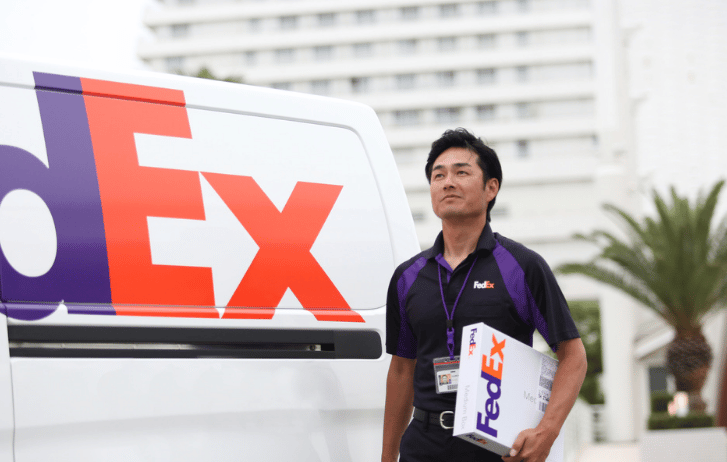
For businesses ready to act on international demand, reliable cross-border logistics is what turns opportunity into execution. Robust infrastructure, customs expertise, shipment tracking, and flexible delivery options all help exporters serve customers across markets with greater confidence. For businesses managing both inbound and outbound shipments, these capabilities also support day-to-day operations.
FedEx, for example, connects Japanese SMEs to more than 220 countries and territories, with hubs located in Narita and Kansai International Airport. Recently, we’ve also improved shipping times from key cities in Aichi and Gifu prefectures to support exporters in the Chukyo Industrial Zone. These service enhancements help create more responsive supply chains and enable businesses to move goods into important markets faster.
AI and digital tools accelerate business adaptability
Alongside market diversification, Japanese SMEs are undergoing broader digital transformation, investing in artificial intelligence (AI) and other digital technologies to improve business agility. Manufacturers and e-commerce brands alike are exploring how these tools can improve responsiveness amid shifting trade conditions.
For many businesses, the value of AI goes beyond automation, extending to faster decision-making and better visibility across operations. Companies are increasingly using AI in the supply chain to support demand forecasting, inventory optimization, procurement planning, and market analysis. These insights can help exporters make informed decisions about which products to prioritize, where to allocate stock, and when to adjust production.
Some companies, for example, are using AI trained on operational knowledge to improve internal decision-making and identify opportunities for process optimization. Others are applying AI to analyze sales patterns and forecast demand more accurately, helping reduce inventory losses and improving supply chain efficiency.
Consumer-facing businesses are also adopting AI to accelerate product development and market research. AI-driven analysis tools can shorten research timelines while helping companies respond more quickly to changing customer preferences across different international markets.
At the same time, logistics providers are integrating AI in the supply chain to support shipment visibility, customs documentation, and route planning. Such intelligent tools can help businesses reduce manual steps in the shipping process.
For Japanese SMEs shipping to the US, we’ve introduced AI-powered features in FedEx Ship Manager. These tools prompt exporters to provide specific item descriptions and select the corresponding HTS codes for US-bound shipments, helping businesses remain compliant with the latest customs requirements while saving time and effort.

Physical AI ushers in the next phase of operations
Japan is also emerging as a vital development center for physical AI – technologies that combine AI with robotics and real-world operational systems. Built on Japan’s longstanding manufacturing and robotics expertise, these technologies can help expanding businesses respond more flexibly to workforce shortages and productivity challenges.
Unlike traditional industrial automation, physical AI systems adapt dynamically to real-world conditions through real-time analysis and autonomous decision-making. In logistics and manufacturing environments, this means robots and automated systems can adjust routes, coordinate workflows, and respond to operational changes with minimal human intervention.
Companies are exploring how AI-enabled robotics can improve flexibility in areas such as warehouse management, production planning, and material handling.
Some initiatives in Japan are already combining robotics with advanced communication infrastructure to enable low-latency, real-time operational coordination. Others are developing modular robotic systems that can be deployed and reconfigured quickly based on site conditions or production needs.
These technologies are still in the early stages of adoption, but they point toward a broader shift in how SMEs scale and expand, whether domestically or internationally. In the future, agility will depend on both organizational decision-making and innovations in intelligent automation.
Staying agile for international growth
As global business environments become more diverse and interconnected, the ability to adapt quickly is becoming a hallmark of competitiveness.
For Japanese companies, this means balancing long-term strategic planning with the flexibility to respond to changing business trends, market conditions, and operational realities. Diversified international expansion, investment in digital capabilities, and stronger operational coordination are all becoming part of this broader effort.
Importantly, Japan’s SMEs are finding new ways to stay agile by reaching overseas customers, analyzing market opportunities, and managing international operations through cross-border commerce and logistics solutions.
As international markets continue to evolve, companies that can combine reliable operations with fast, informed decision-making will gain an edge in capturing new opportunities across the global economy.
SHARE THIS STORY



Trending Topics
Most Popular
- 85% Of APAC Businesses Plan To Expand Into Europe, According To New FedEx Report
- Generative AI: A New Frontier
- How To Ship A Giant Panda
- The Rise Of Intra-Asia Trade: Opportunities In The China-Southeast Asia Corridor
- Where Do Old Planes Go When They Retire?
- What’s So Dangerous About Coconuts? Your Guide To Dangerous Goods Logistics

Sign up now and save on your shipping rates!
Sign up now and earn discounts by shipping instantly with FedEx Ship ManagerTM at fedex.com.
Recommended For You

How To Succeed In Cross-Border Commerce With Timely Delivery
Timing matters. For businesses and e-commerce players to thrive cross-border, global time-definite delivery is crucial.
Read More
Predicting The Unpredictable: How AI Keeps Logistics And Supply Chains Moving
Supply chain disruption has become the new normal. How are logistics providers leveraging AI’s predictive capabilities to help SMEs manage risks?
Read More