
How E-Commerce Shipping Automation Simplifies Fulfillment For SMEs
By FedEx | First published: November 3, 2023 Updated: September 16, 2026
Every new order can set off a series of shipping tasks. Automating repetitive steps – from importing order data to creating labels and submitting trade documents – can help e-commerce businesses save time, reduce manual work, and scale more efficiently.
- Retail teams can spend a significant share of their time on manual tasks, with fulfillment alone potentially adding up to hundreds of working hours each year.
- E-commerce shipping automation can reduce repetitive work in areas such as order imports, label creation, tracking updates, and trade document handling.
- A practical approach is to automate predictable, high-volume tasks first while keeping people in the loop where human judgment, review, or exception handling matters.
Every new order is a reason to celebrate – until a mountain of tiny admin tasks turns that win into hours of extra work.
Behind the scenes, every online sale can involve a series of repetitive tasks. Someone may need to enter order details, prepare a shipping label, arrange pickup, handle trade documents, and share tracking information. That’s manageable when you’re shipping a handful of orders. However, as order volumes rise, those small tasks can quickly add up.
Today, merchants still spend 40% of their time on manual tasks that could otherwise be automated. E-commerce shipping automation is one practical way to reduce that workload, potentially freeing up around 10 hours per week for higher-value work.

Why fulfillment gets harder as your business grows
Order fulfillment can take up a substantial part of the workweek. For example, 62% of apparel merchants spend 2 to 10 hours a week on fulfillment-related activities, including label printing, order entry, carrier selection, and shipment management. That adds up to roughly 104 to 520 hours a year spent on fulfillment tasks.
For cross-border shipments, fulfillment can become even more time-consuming. Businesses may need to prepare shipment documentation, select international logistics providers, and keep customers informed. When each step requires manually transferring data between systems, more orders can mean more repetitive work.
E-commerce automation can streamline many of these steps. The goal isn’t to replace people, but to let technology handle repetitive tasks so employees can focus on decisions that require critical thinking.
How automation benefits your business
The value of automation depends on where you apply it. First, automation can speed up order processing. Connecting your online store with shipping software can reduce the need to re-enter customer details and order information every time someone makes a purchase.
It can also help minimize errors caused by manual data entry, as copying addresses, shipment details, or tracking numbers between systems creates more opportunities for mistakes.
Automation can make customer communication more consistent as well. Shipping and tracking information can flow automatically between connected systems without requiring someone to update each order manually.
Most importantly, as businesses grow, automation can make it easier to scale. Instead of adding administrative steps as order volumes rise, businesses can build repeatable workflows to manage shipments more efficiently. This gives teams more time to focus on higher-value work that benefits from human judgment, such as product development, customer service, supplier relationships, sales, and marketing.
How to use automation in your e-commerce shipping process
You don’t need to automate your entire fulfillment operation at once. Start by using e-commerce shipping automation tools for tasks that occur frequently, follow predictable rules, and involve repetitive data entry.
1. Order imports and shipping labels
Creating a shipment typically starts with entering customer information such as the recipient’s name, address, and order details.
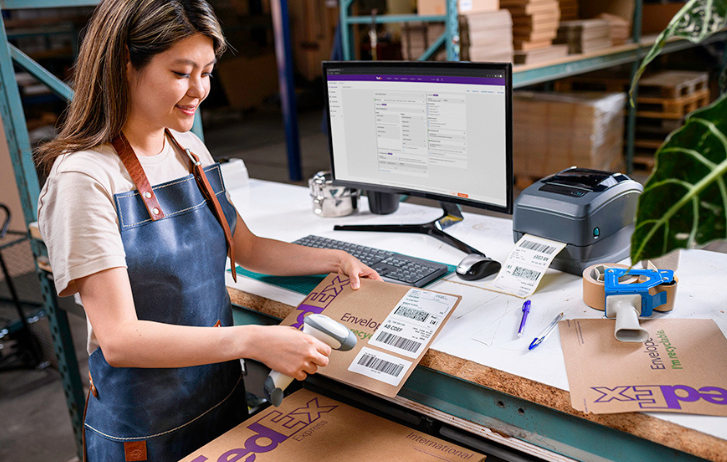
Connecting your store to a shipping tool can automatically transfer this information into the shipping workflow, reducing repetitive data entry and speeding up label creation. It’s one of the simplest ways to automate e-commerce shipping.
FedEx Ship Manager, for example, can connect with supported e-commerce platforms, automatically importing orders and prefilling shipment information.
2. Batch processing and repeat shipments
As daily order volumes increase, creating shipments individually can become inefficient. Batch shipping tools allow businesses to create and manage multiple shipments at once. For businesses that frequently receive recurring orders, saved shipment profiles are another useful feature that can help you prefill commonly used information.
FedEx Ship Manager, for instance, supports batch shipping by allowing businesses to upload a single file to create and print hundreds of shipment labels in one go. It also supports shipment profiles for recurring orders. Both these features remove repetitive steps without requiring businesses to redesign their entire fulfillment process.
3. Tracking notifications
When tracking information has to be copied manually from a shipping platform to an e-commerce store, it creates unnecessary work. Integrated tools such as FedEx Ship Manager enable you to automatically synchronize tracking information and set tracking notifications for both your business and recipients. This can make customer communication more consistent without creating another manual task for your team.
4. Commercial invoices and trade documents
Moving goods across borders often creates additional paperwork. Commercial invoice automation for e-commerce shipments helps minimize repetitive document handling while still allowing shippers to review the information before submitting it.
One example is FedEx Electronic Trade Documents, which allows eligible shippers to submit trade documents such as commercial invoices electronically. Businesses can upload their own paperwork or use FedEx’s commercial invoice generator to prepare documents. Not only does this digital solution cut down on printing costs and manual effort, it also allows you access to preclearance assistance.

Make shipping automation work for your business
The value of e-commerce shipping automation lies in its ability to handle routine tasks that can take up more time as your business grows. Connecting your online store to your shipping system can reduce repetitive data entry, speed up label creation, simplify trade document handling, and automate tracking updates for customers.
With less time spent on repetitive tasks, you can focus more on the parts of your business that technology can’t replace – your products, customers, people, and future opportunities for growth.
SHARE THIS STORY



Trending Topics
Most Popular
- 85% Of APAC Businesses Plan To Expand Into Europe, According To New FedEx Report
- Generative AI: A New Frontier
- How To Ship A Giant Panda
- The Rise Of Intra-Asia Trade: Opportunities In The China-Southeast Asia Corridor
- Where Do Old Planes Go When They Retire?
- What’s So Dangerous About Coconuts? Your Guide To Dangerous Goods Logistics

Sign up now and save on your shipping rates!
Sign up now and earn discounts by shipping instantly with FedEx Ship ManagerTM at fedex.com.
Recommended For You

How Automation Solutions Help B2B SMEs Trade Smarter And Grow Faster
Automation solutions don’t just streamline business operations – they can be a powerful growth engine for B2B SMEs. Here’s how.
Read More
Delivering Exceptional Customer Service Starts With Smarter Logistics
Great customer service is key to business success. Here’s how logistics technology helps you deliver the convenience and clarity your customers want.
Read More
How New Technologies Deliver Smarter Supply Chains
Emergent technologies like AI are making supply chains smarter, more resilient and agile. We dive deeper into their potential for FedEx and Asia SMEs.
Read More