
Empowering Businesses To Scale As Global Trade Evolves
As global trade flows shift, digital disruption accelerates and uncertainty becomes a constant, supply chain resilience has emerged as a defining capability for small and medium‑sized enterprises (SMEs) seeking to remain competitive and scale with confidence.
Speaking at the 2026 FedEx Small Business Grant Contest in Asia-Pacific, Salil Chari, President of Asia Pacific at FedEx, highlighted how SMEs are responding to these changes and what is shaping the next phase of growth for the region’s entrepreneurs.
“We are seeing a fundamental shift in how SMEs think about supply chains,” Chari noted. “Resilience today is not just about recovery, but about building the agility to adapt and grow amid ongoing change.”
Data And Technology As The Backbone Of Adaptability
The first shift is the growing reliance on data and digital tools to build adaptability into supply chains. As disruptions become more frequent and less predictable, SMEs are seeking greater visibility across their shipments and operations. This visibility enables faster decision‑making, better risk management and the ability to respond in real time to changes in cost, capacity or regulation.
Capturing Opportunity As Trade Flows Evolve
The second shift is how SMEs are responding to changing trade patterns across Asia-Pacific. As tariffs and regulatory frameworks evolve and supply chains diversify, intra‑Asia trade is playing an increasingly important role. Many SMEs are identifying new market opportunities closer to home and reconfiguring their supply chains accordingly.
Chari underscored that FedEx’s extensive regional network is designed to support this transition, enabling SMEs to access new growth corridors, improve connectivity across Asia and build resilience through market diversification.
Scaling Through The Right Partnerships
The third shift is a renewed focus on partnerships that enable scale. SMEs and startups often operate with limited resources and time yet compete in increasingly complex and globalized markets.
“For smaller businesses, having the right partner can make the difference between staying local and competing on a global stage,” Chari said. “For companies that move physical goods, FedEx brings together local market expertise and a global network to help them grow with confidence.”
Together, these shifts point to a broader transformation underway across Asia-Pacific’s SME ecosystem. As businesses adapt to a more dynamic trade environment, resilience, connectivity and partnership are becoming the foundations of sustainable growth.
Meet the four finalists of the 2026 FedEx Small Business Grant Contest in Asia-Pacific, who exemplify how innovation, adaptability and ambition are shaping the future of enterprise in the region.
Singapore – Aether Fuels: Delivering sustainable aviation fuel at scale
Aether Fuels is a Singapore-based sustainable fuel technology startup founded in 2022 with the aim of converting carbon feedstock into sustainable fuels for the aviation and shipping industries.
“Aviation contributes about 3% of global carbon emissions every year and it’s one of the most difficult industries to decarbonize,” said Conor Madigan, CEO of Aether Fuels. “Around the world, governments are putting in place mandates for the aviation industry to slash its emissions.”
According to the company, its proprietary technology can convert waste streams—such as carbon dioxide, biogas, agricultural waste and industrial off-gasses—into sustainable aviation fuel at scale, in an economically viable way to meet demand.
The company is developing “Project Beacon,” a commercial sustainable aviation fuel plant in Singapore, expected to produce up to 2,000 tons of fuel annually when operations begin in 2028.
Aether Fuels has raised more than US$50 million from leading investors, including the Singapore Economic Development Board, Temasek’s Xora Innovation, AP Ventures, JetBlue and Chevron Technology Ventures.
Australia – Sicona Battery Technologies: Unlocking high-energy-density batteries of the future
Founded in 2019, this deep tech startup produces new anode materials for lithium-ion batteries. SiCx, Sicona’s technology, blends silicon nanoparticles and graphite to improve performance, enabling up to 20% higher energy density over conventional graphite-only battery cells (reducing battery size) and a 40% faster charging rate, according to the company.
“We set out to make a material that would unlock and enable the high-energy-density batteries of tomorrow, but most importantly, it doesn’t cost the earth,” said Andrew Minett, Cofounder and CTO of Sicona Battery Technologies.
Sicona said it has raised around US$50 million in funding over the past six years, with backers including VC firms Artesian, Waratah Capital, Riverstone Ventures, Chaos Ventures and Investible Climate Tech Fund. The company has signed a strategic partnership and technology licensing agreement with Indian specialty chemicals manufacturer Himadri, which will invest A$15 million (US$9.9 million) in the startup and establish a SiCx plant in India.
Singapore – Venti Technologies: Changing the way goods move through the supply chain
Founded in 2018 by MIT veterans, Venti Technologies is an AI-powered autonomous vehicle startup based in Singapore and Boston. Its autonomous logistics solutions are tailored for complex environments such as industrial hubs, ports and airports.
Through its partnership with PSA Singapore, one of the world’s largest container hubs, the company is deploying self-driving vehicles to transport shipping containers across three terminals in Singapore over four years.
“We’re looking to change the way goods movement is done in the supply chain,” said Heidi Wyle, CEO of Venti Technologies, noting that inefficiencies in these systems cost about US$600 billion a year.
Venti raised US$28.8 million in its Series A funding round, led by LG Technology Ventures, with participation from new investors Safar Partners and UOB Venture Management, as well as existing investors Alpha JWC and LDV Partners.
China – Linkerbot: Developing robotic hands that perform human tasks with precision
Beijing-based robotics startup LinkerBot develops dexterous robotic hands that enable humanoids to perform human tasks with precision. Founded in 2023, LinkerBot now has four offices in China: Beijing, Shanghai, Hangzhou and Shenzhen, according to Su Yang, Cofounder of LinkerBot. Since its founding, Linkerbot has raised US$40 million in funding from investors, including fintech giant Ant Group, Chinese investment bank CICC and HongShan (formerly Sequoia China).
“We use data to train the model, then use the model to scale the system, which in turn improves the robotic hand,” said Yang.
LinkerBot has developed a broad range of dexterous hands with varying degrees of freedom, priced from 8,800 yuan (US$1,226).
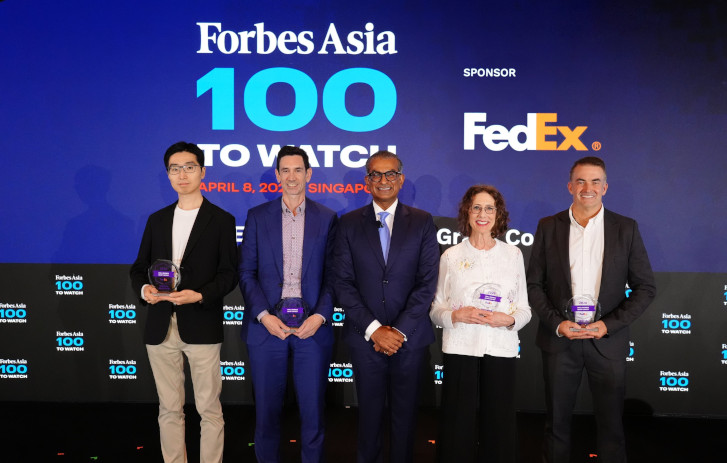
Salil Chari, President, Asia Pacific, FedEx (middle) with finalists of the FedEx Small Business Grant Contest (l-r) Su Yang, Cofounder of LinkerBot; Conor Madigan, CEO of Aether Fuels; Heidi Wyle, CEO of Venti Technologies and Andrew Minett, Cofounder and CTO of Sicona Battery Technologies
This year, Venti Technologies emerged as the grand prize winner, receiving a cash award of US$30,000. The three other finalists each received US$13,000.
“The entrepreneurs recognized this year reflect the extraordinary pace of innovation across Asia-Pacific,” said Chari. “From clean energy, robotics, to autonomous mobility, these companies are solving real‑world challenges with scalable, technology‑driven solutions. At FedEx, we support businesses not only through funding, but by enabling smarter, data‑enabled supply chains and reliable cross-border logistics that help them reach new markets with confidence. This contest reflects our commitment to empowering the next generation of leaders as they grow beyond local borders and compete on the global stage.”
More from Small Business Center

How chips are raising the stakes for Asia’s auto trade
As cars become software-defined, speed, visibility, and resilience are redefining global logistics.

Malaysia market insights and trade opportunities
Discover Malaysia’s vibrant business landscape with top infrastructure, skilled talent, and strong digital adoption, strategically connecting business.