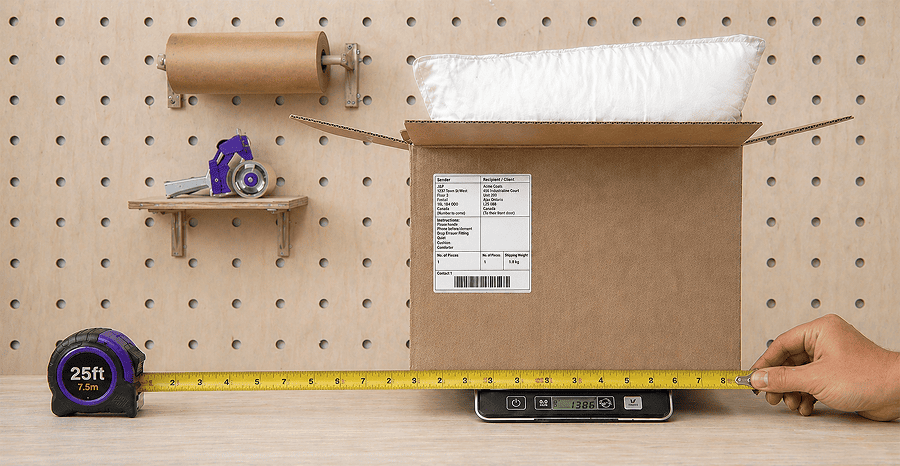


Dimensional weight explained
Dimensional weight, DIM weight, volumetric weight or cubed weight reflects a package’s density. Learn how it’s used and calculated to better understand your shipping costs.
What is it used for?
It’s used by carriers to determine the weight of a package, which determines the shipping costs. The bigger your shipment, the higher the dimensional weight. But if the actual weight is higher than the dimensional weight, then carriers use the actual weight.
How is it calculated?
You can work out the DIM weight of your package pretty easily. But first you need to know which weight divisor your chosen shipping company uses as it varies from carrier to carrier. The most common divisor is 5000 (139 for imperial) so we’ll use this as an example.
To calculate the dimensional weight of a package you multiply the length by width by height and divide it by the dimensional weight divisor.
length x width x height
_____________________
weight divisor
So for example, if you have a box that’s 36 cm x 25 cm x 16 cm and your carrier uses a dimensional weight divisor of 5000, your DIM weight is 3 kg.
It’s the same principle with the imperial system. If you have a box that measures 15 in x 10 in x 6 in, just multiply these values and divide it by 139. This will give you a DIM weight of 7 lb.
Can I reduce the DIM weight?
Unlike the actual weight of your package, you can reduce the DIM weight by choosing a smaller package. This will also cut down your shipping costs.


Make sure to check the rules and regulations of the country you're shipping from and prior to shipping. You can find this information on government websites.
Start shipping with FedEx
Take advantage of great savings and get your shipments moving.