Protecting AI Assets with Real-Time Tracking and Precision Handling
Published: July 2, 2026
As AI chips grow more complex and more expensive, and demand becomes greater, the value of each shipment continues to rise. Logistics is no longer a supporting function. Instead, it has become a protective layer that preserves yield, safeguards revenue, and ensures customers receive fully reliable components ready for deployment.
Here's what you'll find on this page:
The logistics challenges of semiconductor testing and packaging
While QA managers and engineers are deeply aware of how fragile AI components are, their challenge lies in building a logistics strategy that mitigates risk of damage and delayed shipments.
AI infrastructure components are particularly vulnerable to shock and temperature fluctuations, and high-frequency movements among fabs, assembly and test hubs, and systems integrators increase risk exposure. While large multinational corporations can afford dedicated logistics departments to map out these movements, manage customs clearance, and meet tight delivery windows, small and medium businesses require a simpler solution.
In particular, small and medium-sized businesses can benefit from a logistics partner that provides a single point of contact and a single system of work. With the right partner, growing businesses can also access premium services and the expanded global network they need to scale. Additionally, when major weather events or sudden capacity demands threaten strict delivery windows, smaller businesses should be able to rely on their partners to help them manage these risks with the same agility as a tech giant, keeping the supply chain moving.
Assembly and test logistics risks and how to mitigate them
| Risk | Solution | Outcome |
|---|---|---|
| Shock and vibration | High-integrity transport, monitoring and intervention, and specialized packaging | Mitigates damage risk through reliable, controlled handling and monitoring for vibrations and shock |
| Temperature fluctuations | Climate-controlled shipping (Cold Chain) | Protects temperature-sensitive wafers and specialty chemicals |
| Tight delivery windows, increasing capacity demands, and regional supply shocks | Global transportation networks and reliable, time-definite delivery that support “just-in-case” and geographically diverse supply chains | Builds redundancy and resiliency that keeps critical components moving |
How to mitigate supply chain risks using near real-time tracking data
Sensor-based intelligence tools can help those involved in assembly and test to proactively mitigate shipping and handling risks by providing near real-time monitoring of location, temperature, and shock, temperature, and location. This data allows businesses to work with their courier to actively manage a shipment's journey and intervene before minor issues become major disruptions.
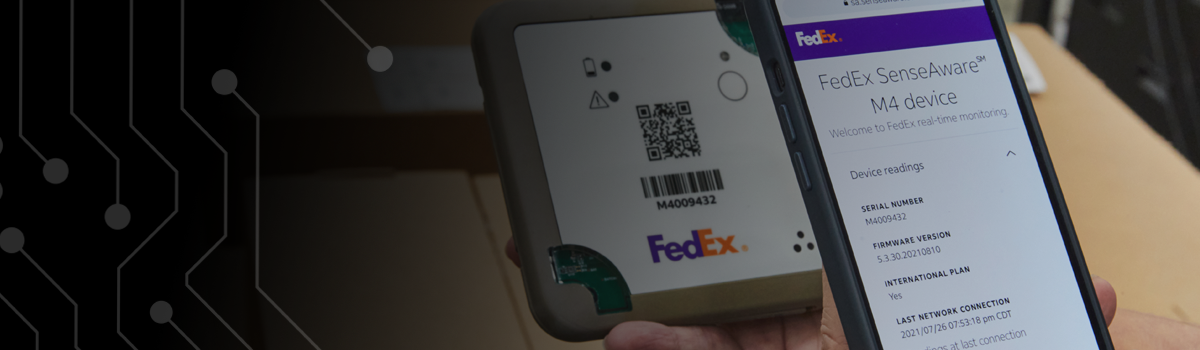
Tracking and risk mitigation with FedEx SenseAwareSM
While some tech giants may track their own packages and use IoT to monitor factors like temperature and shock, FedEx makes sensor-based intelligence accessible to small and medium sized businesses with SenseAware ID.
These lightweight, compact sensors can be placed onto your package at pickup and use Bluetooth Low Energy (BLE) to deliver precise package location data every two seconds to WiFi access points or gateway devices throughout our network. This means that packages equipped with these sensors get tracked hundreds of times throughout their journey, providing total transparency into the condition of your valuable shipments.

SenseAware ID is available as part of our near-real-time monitoring and intervention solution, FedEx Surround®. This white-gloved solution lets customers see and manage their shipments in one place, stay updated about possible delays in advance, and make contingency plans when needed—making it ideal for those with large‑scale, mission‑critical requirements.

Case Study: How Micron enhanced logistics with digital intelligence
As one of the largest global producers of memory and storage solutions, Micron has developed an in-house control tower for supply chain metrics, ensuring continuous visibility and reducing manual touchpoints. To further enhance predictive accuracy, reliability, and security with an expanded view of supply chain effectiveness, Micron turned to FedEx.
FedEx has deployed a combination of digital intelligence tools – FedEx Surround®, FedEx Visibility Insights, and FedEx Sustainability Insights—to offer a service uniquely matched to Micron’s adoption of AI. These tools help to automate frequently recurring tasks and bring more attention to potentially ‘at-risk’ shipments to improve the recovery rate for on-time shipments.
Enabled by FedEx Dataworks technology, these digital solutions collect the massive amounts of data FedEx gathers each day from systems, sensors, and scans throughout the global network. This data is then combined with the power of AI and machine-learning tools to provide an expanded view of supply chain effectiveness.
These solutions have led to a 44% improvement in estimated delivery dates to customers. Additionally, the recovery rate for Micron’s on-time shipments has improved by 27%, and the overall transit time has been reduced by 16%, enabling faster deliveries to Micron’s customers worldwide.
Key takeaways: Keep your semiconductor supply chain moving
Protecting nanometer-scale components that power the AI revolution requires assembly and test facilities and QA managers to treat logistics as a strategic asset. Partnering with a logistics provider that offers reliable, time-definite delivery and transparency of shipments is essential.
Steps to keep your semiconductor supply chain moving:
-
Prioritize high-integrity physical transport: Use specialized packaging and climate-controlled solutions to mitigate risk of damage to delicate components during transit.
-
Embrace "just-in-case" multi-hub coordination: Diversify your shipping routes to build in regional redundancy, ensuring production keeps moving even during sudden supply chain disruptions.
-
Deploy sensor-based intelligence: Use advanced tracking devices like FedEx SenseAwareSM to monitor location, light exposure, humidity, temperature, and shock events.
Frequently asked questions (FAQ)
Why do AI assets require special handling during transport?
AI assets require special handling because nanometer-scale components are highly vulnerable to shock, electrostatic discharge, and temperature fluctuations during transit. Using climate-controlled transport and solutions such as sensor-based monitoring can mitigate risk and ensure that these high-value chips arrive safely and ready for deployment.
How does precision handling reduce supply‑chain risk?
Precision handling and sensor-based monitoring directly reduce the risk of downstream supply chain disruptions by enabling logistics teams to proactively intervene during transit, safeguard shipments, and ensure critical AI hardware arrives fully operational.
How can I protect shock-sensitive hardware and AI components during transit?
Mitigate risk by partnering with a logistics provider who can offer high-integrity transport and using customized freight packaging designed to absorb vibrations. Pairing this with sensor-based tracking ensures any shock events are instantly flagged and addressed.
How can I safely transport temperature-sensitive silicon wafers?
Cold chain logistics, including end-to-end climate-controlled shipping, can help you to prevent thermal damage to sensitive silicon and specialty chemicals.
More from Small Business Center
Fast-Track AI Innovation with Reliable Logistics from Design to Foundry
Find out how AI startups can overcome common logistics challenges and keep the semiconductor supply chain moving.

Why Scaling AI Infrastructure Requires a Sustainable Logistics Strategy
Learn how businesses can help scale the compute environment while meeting ESG requirements.