Cold Chain Logistics: Best Practices To Ship Temperature-Sensitive Goods Safely
By FedEx | April 29, 2026
If your business involves temperature-sensitive goods, success starts with reliable cold chain shipping. These best practices can help reduce risk and manage delays, creating a strong operational foundation for scaling into new markets.
- A wide range of industries rely on cold chain logistics to safely transport temperature-sensitive goods, including fresh produce, pharmaceuticals, cosmetics, and other consumer products like tobacco.
- When even minor transit delays can lead to temperature deviations, businesses need careful planning and real-time visibility to prevent disruptions from resulting in product spoilage.
- Small businesses can work with logistics providers to gain greater control through advanced tracking capabilities, delivery route optimization, and robust cold chain infrastructure.
Moving temperature-sensitive goods across the world requires a high degree of precision. A temperature shift of just a few degrees can cost a business thousands of dollars in spoilage. In the pharmaceutical industry, for instance, cold chain failures are estimated to result in annual losses of up to USD 35 billion globally.
Whether your business is shipping flowers, fresh fish, or pharmaceuticals, the difference between profit and loss often comes down to reliable cold chain logistics. The right strategy helps safeguard product quality during transport and distribution, maintain customer trust, and meet regulatory requirements. Here’s how to protect your shipments at every step of the journey.
How does cold chain logistics work?
Cold chain logistics involves the transport and storage of temperature-sensitive products. By keeping goods within specified temperature ranges, cold chain management helps to preserve their safety, quality, and efficacy.
This process relies on a series of interconnected solutions that maintain consistent temperature conditions:
-
Specialized packaging typically includes insulated containers, dry ice, and gel packs, which form the first line of defense against temperature fluctuations.
-
Cold storage facilities, such as warehouses and distribution centers, provide sophisticated refrigeration systems and humidity control to maintain cargo under controlled conditions before shipping.
-
Temperature-controlled transportation includes airplanes, ships, trucks, and vans equipped with refrigeration and insulation to move goods safely through the supply chain.
Together, these solutions form a continuous cold chain from pickup to last-mile delivery.
Cold chain logistics: A must for many industries
For companies dealing in temperature-sensitive goods, cold chain shipping is essential to enabling growth. By preventing damage and loss, an efficient cold chain network allows your business to meet consumer demand and expand into new markets with confidence.
In Asia Pacific (APAC), the cold chain logistics market is rapidly expanding at a projected CAGR of 13.9% between 2024 and 2031. This growth is driven by rising demand for fresh produce and pharmaceuticals, where consistency and control are non-negotiable.
Key categories such as fresh and frozen foods, along with pharmaceuticals such as vaccines and stem cells, are commonly transported via cold chain logistics. However, a wide range of other products also require precise temperature control in transit:
- Cosmetics: High temperatures can cause emulsions like creams and serums to separate. Products containing Vitamin C, probiotics, and other active ingredients can also degrade with heat exposure.
- Automotive parts: EV lithium batteries are highly sensitive to temperature fluctuations, while electronic components can be affected by humidity.
- Fine art: When it comes to antique artwork, even small temperature changes can damage delicate materials, such as cracking paint on canvas. Uncontrolled humidity may also lead to mold growth or warping.
- Cigarettes: Tobacco products require controlled temperature and humidity to maintain quality. Excess moisture can affect usability, while low humidity can cause them to dry out.
Best practices to optimize cold chain logistics
When moving temperature-sensitive cargo across borders, every detail matters. Goods need to stay within optimal temperature ranges through multiple handovers, border controls, storage points, and varying climates. Each step introduces risk – even minor delays can expose shipments to external fluctuations.
To reduce the likelihood of costly disruptions, businesses need a combination of careful planning and real-time visibility. Here are six best practices to help improve cold chain risk management.
1. Protect your products with proper packaging
The right packaging creates a portable microclimate around your products, protecting them from external temperature fluctuations. That’s why it’s critical to choose packaging tailored to your cargo’s temperature requirements and shipping duration.
Temperature-controlled packaging solutions come in two main types: active and passive.
- Active packaging typically uses electrically powered cooling or heating systems. With a reliable power source, it can maintain specific temperature ranges for extended periods, making it suitable for long-haul transportation and extreme environments. Such solutions can be as large as a Unit Load Device (ULD), enabling efficient high-volume shipping.
- Passive packaging combines insulated containers or courier bags with coolants such as dry ice, gel packs, or phase change materials (PCM). These solutions can maintain specific temperature ranges for a limited duration, typically between 24 and 96 hours or longer depending on configuration. This makes them a cost-effective option for shorter distances and smaller shipments.
It’s best to choose validated packaging that has been rigorously tested, especially for highly sensitive items like pharmaceuticals. If in doubt, reach out to your logistics provider to determine the most suitable solution for your shipping needs.
2. Stay compliant with changing regulations
Regulatory requirements for temperature-sensitive shipments vary across markets. Non-compliance can be costly: a customs delay or rejection could result in the loss of an entire shipment due to spoilage.
To keep up with evolving regulations, businesses should regularly audit and validate their cold chain management processes. In addition to country-specific requirements, operations should align with global industry standards, such as:
- The International Air Transport Association’s (IATA) Perishable Cargo Regulations
- The World Health Organization Good Distribution Practices (GDP) for pharmaceuticals
- Hazard Analysis and Critical Control Points (HACCP) for food safety management
To demonstrate compliance, your business needs systems in place to monitor and record temperature conditions throughout the cold chain.
Digital tools such as Internet of Things (IoT) sensors can simplify this process by automatically capturing temperature readings and timestamps. You don’t necessarily need to invest in these technologies directly – many logistics providers like FedEx offer digital solutions that enable near-real-time shipment tracking, cold chain breach management, and transparent data reporting.
3. Implement continuous monitoring in transit
You can’t manage what you don’t monitor. Continuous monitoring is key to maintaining cold chain integrity, enabling early detection of issues and timely corrective action.
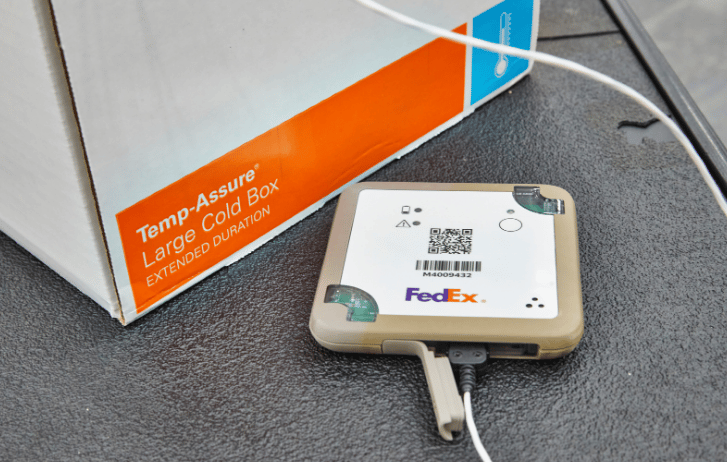
Today’s advanced tracking technologies make it possible to remotely verify a shipment’s location and condition in near-real-time. Devices such as Bluetooth Low Energy (BLE) sensors and IoT-enabled data loggers can track not only temperature, but also humidity levels, light exposure, and more.
Besides offering a verifiable digital trail for compliance, these tools help teams to respond to temperature deviations during transit. At FedEx, we’ve enhanced this capability with FedEx Surround, a monitoring and intervention suite that provides near-real-time visibility into critical shipments.
Our FedEx Surround Premium service tier includes on-package sensor monitoring through SenseAware ID – lightweight BLE sensors that deliver precise package location data every two seconds. Combined with 24/7 intervention capabilities and proactive cold chain recovery, any shipment at risk of delays or disruptions can be identified early and supported with appropriate corrective measures to help protect product integrity.
4. Reduce delays with delivery route optimization
Every extra hour a shipment spends in transit increases the risk of a cold chain disruption. Unpredictable factors such as extreme weather, shipping bottlenecks, or simply traffic congestion during last-mile delivery can expose goods to temperature variations.
When every hour counts, route optimization technology can make a significant difference. Powered by AI and advanced algorithms, route planning tools can calculate the most efficient delivery paths based on real-time traffic conditions, vehicle capacity, and delivery time windows. This helps reduce transit times and maintain cold chain integrity.
For example, FedEx uses an AI-powered Stops Sequencing tool to optimize last-mile delivery routes in real time based on package volume and customer requests. Such advanced tools enable logistics providers to improve on-time performance and support more reliable cold chain management.
5. Map out a Plan B
Given the complexity of cold chain logistics, it’s good practice to expect the unexpected. Trucks can break down, refrigeration units can fail, and severe weather can delay flights at precisely the wrong moment. Having a Plan B in place can help protect valuable shipments and turn a crisis into a manageable disruption.
You can prepare for flight delays and equipment failures by creating contingency plans to reroute shipments to nearby cold storage facilities. Work with your logistics provider to identify facilities along your shipping routes, then outline the steps and resources needed to transfer cargo if required.
Healthcare companies shipping temperature-sensitive pharmaceuticals, for instance, can leverage FedEx’s healthcare logistics network, with over 130 cold-chain facilities worldwide. In addition, our global network of Life Science Centers offers temperature-controlled storage solutions ranging from cryogenic to ambient conditions, helping maintain product integrity until shipments can resume transit.
To simplify contingency planning, businesses can also use predictive analytics. Today’s AI-powered predictive models can analyze a wide range of data, including traffic patterns, weather conditions, and other variables, to forecast shipping disruptions ahead of time.
Take FedEx Surround, which draws on AI and machine learning technologies to identify potential disruptions in near-real-time. Businesses receive predictive delay alerts and insights into weather events that could affect shipments, enabling them to make informed decisions with FedEx’s support and activate contingency plans when needed.
6. Embrace sustainable practices
As APAC governments increase regulatory scrutiny around sustainability, businesses are under growing pressure to integrate eco-conscious practices into their supply chains.
However, cold chain operations tend to be more energy-intensive than standard logistics systems. They also generate packaging waste like plastic gel packs. How can your business stay ahead of regulatory pressure and future-proof your cold chain?
One easy way to balance sustainability with product safety is to adopt packaging solutions with recycled or reusable components where appropriate. Instead of polystyrene foam, businesses can use biodegradable or recyclable insulation materials such as wool, cotton, or plant-based foams. In place of gel ice packs that may not fully break down in landfills, choose water-based gel packs that leave no residual impact when properly disposed of. Plus, reusable packaging can further help reduce both waste and costs – a win-win for your business.
Beyond packaging, businesses can lower their carbon footprint through sustainable supply chain practices. This includes investing in energy-efficient refrigeration systems and prioritizing lower-emission transport options such as electric vehicles (EVs) for pickup and delivery.
EVs can significantly reduce tailpipe CO2 emissions during first- and last-mile logistics while maintaining the speed required for temperature-sensitive cargo. To support lower-emission logistics operations, FedEx is progressively expanding its EV fleet across APAC and working towards its goal of achieving carbon-neutral operations by 2040.
Staying cool under pressure
If your business involves temperature-sensitive products, success ultimately hinges on the reliability of your cold chain. While the risk of shipment loss or spoilage may never be zero, these best practices can help you anticipate and manage potential issues. Smart planning, end-to-end visibility, and sustainable solutions can help future-proof your business in an increasingly complex environment.
A cold chain is only as strong as its weakest link, making it essential to choose the right logistics support. At FedEx, we’re committed to operational excellence and compliance with rigorous international standards.
In 2025, we became the first global integrator to achieve CEIV Pharma certification for ground handling across our air hubs and ramps, supporting high standards for safe, compliant, temperature-controlled transport of pharmaceuticals. We were also recognized in 2024 for being the first and only global end-to-end transportation and logistics service provider to earn the ISO 9001 global certification for 30 consecutive years – a status never achieved before in the entire transport industry.
With advanced digital capabilities and validated cold chain packaging solutions, we’re ready to help your temperature-sensitive shipments stay ahead in the race against time and temperature.
***
Learn more about our cold chain logistics solutions here.
SHARE THIS STORY



Trending Topics
Most Popular
- 85% Of APAC Businesses Plan To Expand Into Europe, According To New FedEx Report
- Generative AI: A New Frontier
- How To Ship A Giant Panda
- The Rise Of Intra-Asia Trade: Opportunities In The China-Southeast Asia Corridor
- Where Do Old Planes Go When They Retire?
- What’s So Dangerous About Coconuts? Your Guide To Dangerous Goods Logistics

Sign up now and save on your shipping rates!
Sign up now and earn discounts by shipping instantly with FedEx Ship ManagerTM at fedex.com.
Recommended For You

From Flowers To Frozen Foods: Difficult Items To Pack And How To Protect Them
Items like flowers, seafood, and electronics can be difficult to pack. Here’s how to prepare your sensitive packages for safe delivery.
Read More
Serving APAC’s Appetite: How Cold Chain Logistics Delivers Freshness
Explore how cold chain logistics is transforming food supply in APAC. Discover key trends, frozen food export tips, and how SMEs can scale.
Read More
Cold Chain Logistics: A Critical Enabler Of Biotechnology Breakthroughs
Sensitive goods like vaccines need cold chain logistics to survive in transit. Learn how Boryung BioPharma stays competitive by working with FedEx.
Read More