
European Union (EU) customs changes
Prepare for upcoming EU customs requirements, including Product Identifier (PID) requirements effective November 1, 2026.
What’s on this page?
What’s on this page?
This page explains the European Union's 2026 customs changes for Business-to-Consumer (B2C) shipments, including the removal of the €150 customs duty exemption effective July 1, 2026, and new Product Identifier (PID) requirements effective November 1, 2026.
Key Takeaways
- The EU removed the €150 customs duty exemption on July 1, 2026.
- PIDs become mandatory for B2C shipments up to €150 on November 1, 2026. A transition period will apply following implementation.

Who is affected?
These requirements primarily affect businesses located outside the EU that sell or ship goods directly to consumers in EU member states, including through company websites, online marketplaces, and e-commerce platforms. Businesses shipping to VAT-registered businesses in the EU are subject to different customs requirements.
What changed on July 1, 2026?
On July 1, 2026, the European Union removed the long-standing duty exemption on low-value imports.
As a result:
- The duty exemption for shipments imported into the EU with an intrinsic value of €150 or less was removed—a rule known as the de minimis exemption.
- A flat €3 customs duty now applies per tariff classification (Harmonized System or HS code) declared for low-value shipments. Multiple items sharing the same HS code are typically treated as one line for duty purposes.
- Importers and shippers now need to provide more detailed shipment information to support customs clearance.
Note on Value-Added Tax (VAT): VAT rules are not affected by this change. All goods imported into the EU have been subject to VAT regardless of value since 2021, and this remains unchanged.
What’s changing on November 1, 2026?
Beginning November 1, 2026, Product Identifiers (PIDs) will be required for products sold to recipients in the EU through Business-to-Consumer (B2C) transactions, with a shipment value up to €150. The new requirement means customs data must identify individual products within a shipment, rather than only providing information at the parcel level.
Please note that PID requirements do not apply to products shipped to Value-Added Tax (VAT)-registered businesses in the EU country of destination through Business-to-Business (B2B) transactions.
Understanding Product Identifiers (PIDs)
The new requirement shifts EU customs reporting from parcel-level information to item-level product identification.
What should shippers do now? To help avoid customs clearance delays, ensure shipment information is complete and accurate, including product descriptions, tariff classifications (HS codes), and any other customs data required for the destination country.
- MERCHANT PRODUCT IDENTIFIER (M-PID)
Your product catalogue, inventory management, system, or e-commerce product listing. - NON-STANDARDIZED MANUFACTURER PRODUCT IDENTIFIER (NS-PID)
The manufacturer's product label, packaging, catalogue, or datasheet. - STANDARDIZED MANUFACTURER PRODUCT IDENTIFIER (S-PID)
Under the product barcode or in the manufacturer's product specifications. If it does not exist, use “NO”.
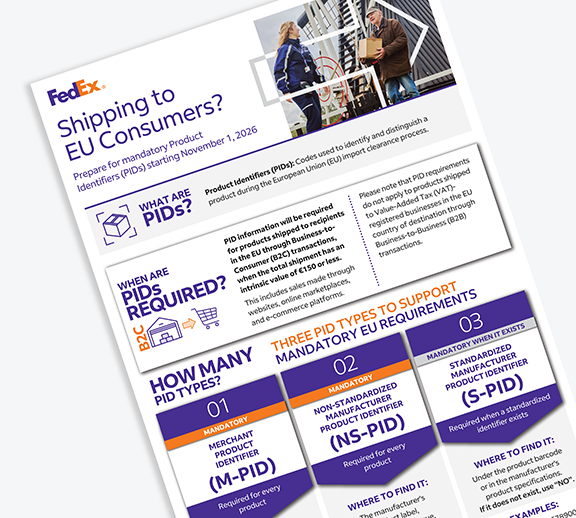
Review our PID Infographic to learn about:
- Which shipments are affected
- Required PID information, including:
- M-PID (Merchant Product Identifier)
- NS-PID (Non-Standardized Manufacturer Product Identifier)
- S-PID (Standardized Manufacturer Product Identifier)
- PID formats and examples
- How to submit PID data
If FedEx is acting as your customs broker at the time of import into the EU customs territory, FedEx will submit these details to the EU customs authorities during the clearance process on your behalf. Start providing PIDs now to prepare for mandatory requirements beginning November 1, 2026, and help avoid potential shipment delays.
Important - Transition Period
Recognizing the challenges businesses may face in preparing for the PID requirements taking effect on November 1, 2026, the European Commission has asked the EU Member States to take a pragmatic and collaborative approach during a transitional period to minimize trade disruption, currently expected to end early 2027.
FedEx will apply interim measures to align with this approach when the PID is missing to ensure business continuity.
Customers should not view this as a postponement of their compliance obligations. FedEx strongly recommends that customers continue their preparations without delay and provide PID information for all applicable shipments (i.e., goods sold through distance sales with an intrinsic value not exceeding €150).
Financial Impact
In addition to new data requirements, importers should also understand the EU fees and charges that may apply to affected shipments.
EU Fees & Charges
In addition to new data requirements, importers should also understand the EU fees and charges that may apply to affected shipments.
|
Charge |
Amount |
Effective date |
|
Customs duty |
€3 per unique tariff classification |
July 1, 2026 |
|
VAT |
Varies per country |
Already in effect |
|
Union handling fee |
Proposed fee (amount and application method subject to final EU confirmation) |
Expected November 1, 2026 |
NOTE: The above table provides an overview of potential charges and is not intended to represent a sample cost calculation. Import duties and other taxes (such as VAT) are imposed by the EU and governmental authorities. Actual landed costs will vary depending on factors such as destination-country VAT rates, shipment characteristics.
Also, government duties and taxes are separate from any FedEx clearance or brokerage fees. FedEx clearance service fees may apply when a shipment requires manual data entry or additional customs processing. For a complete list of applicable FedEx brokerage and clearance fees, visit the FedEx Clearance Fees page.
Information remains fluid and is subject to change. We will share updates on this fee as soon as more information becomes available.
Does the €3 duty apply to your shipments?
|
Scenario |
Exception / Details |
|
|---|---|---|
|
Business-to-business (B2B) shipments to VAT-registered recipients |
If your EU customer is a VAT-registered business in the country of destination or if your shipments are not sold through the Import One-Stop Shop (IOSS) scheme, standard duty rates generally apply instead of the flat €3 duty. |
|
|
Free Trade Agreement (FTA) shipments not sold via the Import One-Stop Shop (IOSS) |
If your goods qualify under a free trade agreement and are not sold through the IOSS scheme, duty relief may be applied. |
|
|
FTA shipments sold via the IOSS |
Even where a free trade agreement applies, if your goods are sold through the IOSS scheme, the €3 customs duty still applies per line/unique HS code on the import declaration. |
While the July 1 changes introduced new customs duty and shipment data requirements, businesses should also prepare for additional product-level reporting requirements that take effect on November 1, 2026.
Resources & Tools

FedEx Ship Manager at fedex.ca PID Guide
Get step-by-step instructions on how to enter PID information.

FedEx Application Programming Interface (API)
Integrate FedEx shipping capabilities into your systems to automatically capture and submit required shipment data, including PIDs.
Do I need to change how I ship low-value orders to the EU?
Possibly. Starting November 1, 2026, all B2C shipments up to the value of €150 to the EU will require PID data. To prepare, ensure your shipping systems can capture and transmit PID information and that product descriptions and tariff classifications are accurate. Low-value goods may now require declaration through a different customs process, which could result in additional documentation. FedEx Electronic Trade Documents can help simplify this transition by reducing manual steps.
I ship from outside the EU. How can I manage unexpected customs-related costs for my customers?
Start by agreeing upfront with your customers on who is responsible for freight charges, customs duties, taxes, and fees. These responsibilities are defined by the Incoterms which should be stated in your sales contract and commercial invoice.
When creating your shipment, select the FedEx shipping terms that match your agreement:
- Use Bill Shipper (or Bill Sender) if you have agreed to deliver goods duty paid, meaning, FedEx will bill you for any customs duties, taxes, fees, and surcharges.
- At checkout - when Import One-Stop Shop (IOSS) is used for VAT, the duty can be taken and paid by the receiver at the point of sale. This should be clearly noted on the commercial invoice and through your Incoterms with delivered duty paid (DDP) and Bill Shipper.
- Paid to the authorities at the time of import – standard customs procedures apply and the rate of €3 per HS line item would apply
- For the new €3 duty on low-value goods with an intrinsic value up to €150 imported by consumers (B2C), payment is expected through one of two options:
Will all EU shipments require PID information?
Beginning November 1, 2026, PID information will be required for products shipped to recipients in the EU through Business-to-Consumer (B2C) transactions, with a shipment value of €150 or less, including sales made through websites, online marketplaces, and e-commerce platforms. Please note that PID requirements do not apply to products shipped to Value-Added Tax (VAT)-registered businesses in the EU country of destination through Business-to-Business (B2B).
How do I enter PID information if I’m not using FedEx Ship Manager at fedex.ca or FedEx API?
FedEx Ship Manager Software or FedEx Ship Manager Server
Electronic PID submission is planned for March 2027. Until then, you can use FedEx Ship Manager at fedex.ca, or include PID data on your shipment documentation, such as your Commercial Invoice or packing list, and upload it when you create the shipment.
FedEx Web Services
Since FedEx Web Services will no longer receive enhancements or platform updates, we strongly recommend migrating to FedEx API. If you continue using Web Services after November 1, 2026, include PID data on your Commercial Invoice or other shipment documentation.
Third-party shipping providers
Confirm with your provider that PID data can be captured and transmitted electronically.
PRO TIP: Please ensure all three PIDs are clearly printed on your Commercial Invoices with the required M-PID, NS-PID, and S-PID headers in the correct sequence.
EU de minimis
The exemption from customs duties and taxes on low-value shipments imported into the EU with an intrinsic customs value of €150 or under. This exemption ended July 1, 2026.
Low-value shipment
A shipment with an intrinsic customs value of €150 or under.
Product identifier
A seller’s code used to identify their products at SKU level.
Harmonized System (HS) code
An internationally standardized system of names and numbers used to classify traded products and determine applicable tariff rates.
Import One-Stop Shop (IOSS)
An EU scheme that enables e-commerce sellers and online marketplaces to declare and collect VAT for B2C distance sales of goods imported from non-EU countries in shipments with an intrinsic customs value at €150 or under, at the point of sale rather than at import.
Union Handling fee
A proposed EU-wide fee on B2C EU imports. Expected to take effect November 1, 2026.
International Commercial Terms (Incoterms)
Standardized international trade terms that define which party is accountable for costs, risks, and responsibilities at each stage of an international shipment between buyer and seller.
FedEx “Bill Shipper” (or “Bill Sender”)
A FedEx shipping term in which the exporting party is charged for customs duties, taxes, fees, and surcharges, in addition to freight. Use this option when you have agreed with your buyer to deliver goods duty paid.