
CPSC implements mandatory electronic filing requirements in ACE
What's on this page?
Effective July 8, 2026, U.S. Customs and Border Protection (CBP) is implementing mandatory electronic filing (eFiling) for Consumer Product Safety Commission (CPSC) Certificates of Compliance through the Automated Commercial Environment (ACE) for CPSC-regulated imports.
This requirement finalizes CPSC’s transition from a voluntary eFiling pilot program to full enforcement as reflected in CBP Cargo Systems Messaging Service (CSMS) #68290359, issued on April 8, 2026.
Mandatory CPSC eFiling becomes effective for entries filed on or after July 8, 2026, requiring customers who import CPSC-regulated products to provide Certificate of Compliance data with their shipping documentation so that it can be electronically transmitted via the CPSC Partner Government Agency (PGA) message set in ACE at the time of entry into the United States. Failure to provide the required information could result in entry delays, shipment holds, examinations, or additional documentation requests.
What products are affected?
The new requirement applies to imported finished consumer products regulated by the CPSC that require certification under 16 CFR Part 1110 (CPSC only regulates finished products).
Examples of affected product categories include, but are not limited to:
- Children’s products:
- Toys and games
- Cribs, bassinets, strollers, and playsets
- Children’s clothing and sleepwear
- Child car seats, carriers, and highchairs
- Household goods and furnishings:
- Furniture (e.g., sofas, mattresses, dressers, bunk beds)
- Rugs, carpets, and window coverings
- Portable fuel containers and candles
- Consumer electronics and electrical products:
- Power adapters and chargers
- Portable lighting products
- Small household appliances
- Battery-operated consumer devices
- Home improvement and recreation products:
- Ladders and step stools
- Sporting and recreational goods
- Outdoor grills and related consumer products
- Textiles and apparel regulated by CPSC rules:
- Flammable fabrics
- Upholstered furniture materials
What data must be provided?
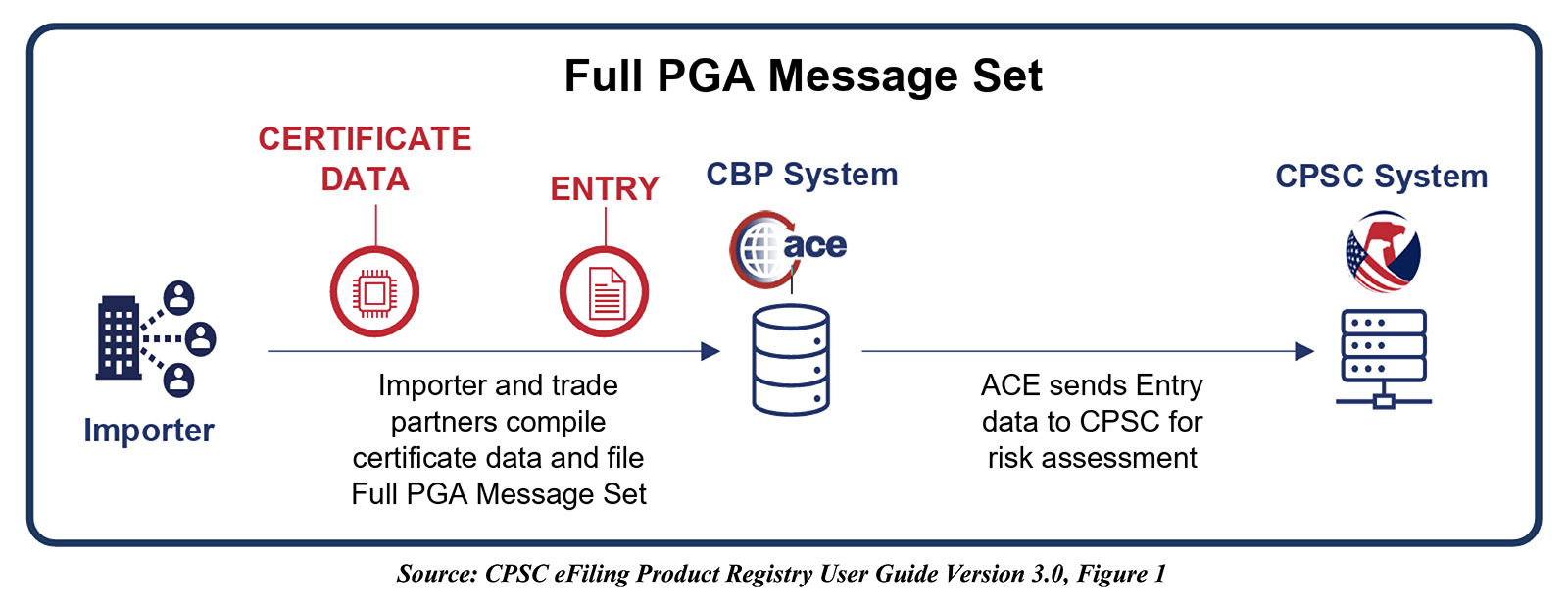
Customers must support ACE filings with CPSC certificate data using one of two eFiling methods, depending on whether or not their product is preregistered in the CPSC Product Registry:
- Full PGA Message Set (Per-Shipment Filing): for products not preregistered in the CPSC Product Registry, importing customers must provide seven certificate of compliance data elements:
a. Product identifier (i.e., Global Trade Item Number),
b .Each applicable CPSC safety rule certified under 16 CFR part 1110,
c. Date of manufacture for the finished product,
d. Name and address for the manufacturer, producer, or assembler,
e. Date of most recent test for compliance with applicable CPSC rules,
f. Name and address for the compliance testing facility or laboratory, and
g. Contact information for the party maintaining records of test results.
- This method is recommended for customers who only import a limited number of CPSC-regulated consumer products or do not repeatedly import the same regulated product.
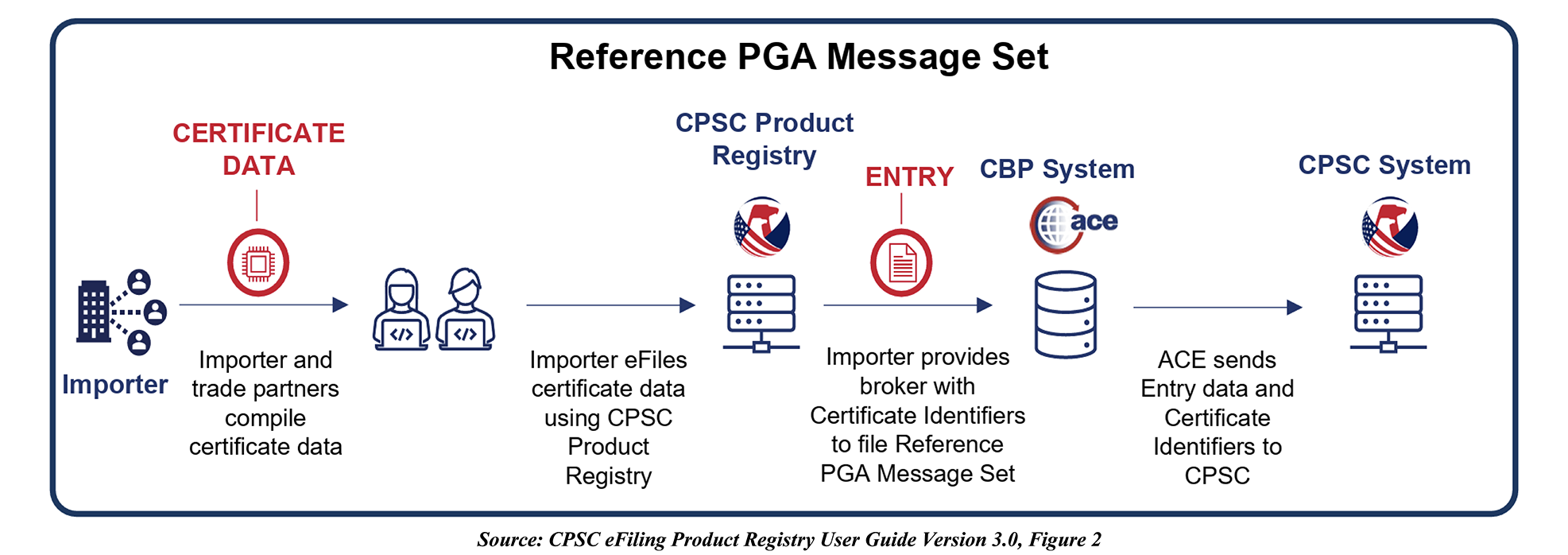
Reference (Abbreviated) PGA Message Set: products preregistered in the CPSC Product Registry qualify for an abbreviated filing method, which only requires customers to provide three data elements:
a. Product ID – a unique identifier for the product being certified,
b. Certifier ID – the unique identifier created by the certifying importer, and
c. Certificate Version ID – the unique identifier for the specific version of the product certificate.
- Product preregistration is optional but strongly encouraged for customers with recurring CPSC-regulated imports covered by the same product certificates to streamline ACE filings and reduce the likelihood of CPSC-related clearance delays.
How do I submit my CPSC Certificate of Compliance data?
You can submit CPSC Certificate of Compliance data using one of three methods, depending on the shipping solution you use:
- FedEx Ship Manager™ at fedex.ca
- FedEx APIs
- Manual submission through supported FedEx shipping solutions
Select the option that applies to your shipping process below.
|
Shipping Solution |
Requirements |
|
FedEx Ship Manager™ at fedex.ca |
Submit your CPSC Certificate of Compliance data directly during shipment creation. |
|
FedEx API |
For high-volume shippers and integrated shipping solutions, CPSC Certificate of Compliance data can be submitted electronically through FedEx APIs. • Electronic submission: Update your current Ship API integration to include the required PGA (Partner Government Agency) data elements. This allows the CPSC certificate information to be transmitted electronically at the time of shipment. • If your integration is not yet updated: If your API integration does not currently support CPSC data submission, download and complete the applicable CPSC form below and include the completed certificate information with your shipment documentation for customs processing. Additional Resources Access FedEx API Developer Documentation |
|
Other FedEx Shipping Solutions |
For the following shipping solutions, CPSC Certificate of Compliance data must currently be submitted manually: |
Download CPSC Certificate of Compliance Forms
If manual submission is required, choose the form that matches your product's registration status in the CPSC Registry.
- Products Not Registered (Not Pre-Registered) in the CPSC Registry
Required: Full CPSC Partner Government Agency (PGA) message set
Download CPSC Product Form — Goods Not Registered (PDF)
Download Instructions for Unregistered Products (PDF)
- Products Registered (Pre-Registered) in the CPSC Product Registry
Required: Abbreviated CPSC PGA message set
Download CPSC Product Reference Form — Registered Goods (PDF)
Download Instructions for Registered Products (PDF)
Frequently asked questions
CPSC eFiling is the electronic submission of Certificates of Compliance for CPSC-regulated consumer products through ACE using the CPSC PGA message set.
Mandatory CPSC eFiling for regulated finished consumer products applies to entries filed on or after July 8, 2026.
The CPSC Product Registry is an optional online system that allows importers to preregister product certificate data and qualify to use the abbreviated message set in ACE.
- Registry use is optional but encouraged for customers who frequently import CPSC-regulated products to simplify entry filing and reduce the risk of CPSC-related shipment delays.
- Please note that it may take some time to complete the CPSC Product Registry process, so it is recommended that customers who want to participate begin the registration process as soon as possible in advance of the July 8, 2026 implementation date.
The CPSC provides a product compliance tool called the Regulatory Robot to help customers determine which CPSC rules apply to each product and what certification requirements are needed. Use of the Regulatory Robot is recommended for compliance planning.
Customers are strongly encouraged to begin preparing as early as possible to avoid disruptions and ensure a smooth transition once eFiling becomes mandatory. Recommended preparatory actions include:
- Identify all products regulated by the CPSC that require certification,
- Confirm that Certificates of Compliance are complete, accurate, and readily available,
- Ensure required certificate data can be shared electronically with customs brokers,
- Review the sources linked below in the Resources section; and
- Customers who regularly import CPSC-regulated products are encouraged to begin registering eligible products in the CPSC Product Registry now, so they can use the abbreviated message set to streamline entry filing and mitigate the risk of CPSC-related shipment delays once the requirement becomes mandatory.
Yes. Certain products under CPSC jurisdiction may qualify for certification exemptions or enforcement discretion, including:
- Items imported as component parts (CPSC only regulates finished products)
- Personal-use items exported for repair and reimported
- Gifted products shipped between two individuals
To find out whether a product qualifies for an exemption, customers should:
a. Confirm whether the imported item is a finished consumer product or a component part,
b. Use the CPSC’s online Regulatory Robot tool to identify: (a) applicable CPSC regulations, (b) whether certification is required, and (c) potential exemptions that may apply, and
c. Check whether the product is subject to CPSC certification rules under 16 CFR Part 1110.
If claiming an exemption, customers must update shipping documentation or provide clearance instructions that indicate a product’s intended end-use and any exemption(s) that may apply to a specific product.
Customers must provide certificate data electronically in ACE by either:
- Submitting full certificate details for each shipment with seven required data elements (recommended for customers who only import a limited number of CPSC-regulated products or do not repeatedly import the same regulated product), or
- Using preregistered product information from the CPSC Product Registry to submit a shorter reference filing with only three data elements (recommended for customers who regularly import CPSC-regulated products to streamline clearance).
You should provide the appropriate disclaim code (A or B). While not mandatory, disclaim codes support CPSC review and may reduce delays.
Shipments may be delayed if required electronic information is not provided with the shipment documentation. Customers are responsible for ensuring accurate certificate information is available at the time of entry to support ACE filings.